This post a while back on water handling reminded me of another geologic feature that's a pain to drill through: faults. (see my last post on this topic and some links to older posts here).
Now, I haven't overseen drilling into any spectacular or famous faults, per se. But I have very rarely drilled into faults of at least local significance - local enough to be mapped and named, anyway.
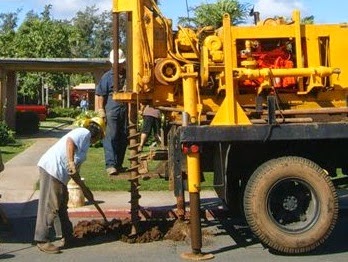
Drilling into faults or fault zones at any depth of significance (say, more than 50 feet or so) leads to two major issues: water production and borehole instability.
Larger scale faults tend to be more than just a single fracture in the bedrock. They may include a fault zone, where the rock for a certain distance is much more fractured and may possibly have a different structure than the parent rock. This may hold a lot of water. And if you're flying along, doing some sort of fast, aggressive drilling such as air-rotary, and creating a borehole with a reasonably wide diameter, you may end up tapping into a lot more water than expected. And depending on the air pressure the driller's using, the drilling rate, and the structure of the rock, the water flow may not just stop once the driller turns off the air pressure. Nothing like watching your frac tanks fill up with contaminated water while you wait for the water to stop pouring out of the borehole!
So, water production is a thing that you can deal with. You get the frac tanks on-line, make sure that you have pumps capable of moving a lot of water, and maybe stop drilling for a bit every once in a while to see how much water you're getting back. Borehole instability is another problem.
Once we install a borehole, we usually like to do a bunch of testing, which involves lowering instruments down there to collect samples and geophysical measurements, installing packers to seal off certain zones for testing, and maybe putting in a permanent system with multiple sample ports. If you have a fracture zone that's at a reasonably steep angle, and bedrock that is not super hard (like a siltstone or sandstone) you may find that the walls of the borehole pinch back in almost immediately. This makes it hard to fish the drill rods out of the borehole, let alone any $10,000 geophysical tooling you'd like to use. You can always try and bang in some steel casing past the obstruction, but at that point you may have shrunk the effective size of the borehole so you can't get the other stuff you need down there, and then you've shut off the rest of the bedrock from evaluation. And multiple boreholes get expensive fast. Another option is to be a lot more cautious up front, and do all your sampling/testing in 10-foot intervals as you drill (with casing above the interval in question), but that does slow the drilling process down and requires much more coordination between multiple contractors, all of whom are being paid for their standby time.
Intercepting a fault/fault zone actually can tell us quite a bit about the regional geology and the structure of the bedrock. We just have to be able to get a borehole in there long enough to do the evaluation.
Showing posts with label drilling. Show all posts
Showing posts with label drilling. Show all posts
Wednesday, January 25, 2017


Friday, December 12, 2014
competitor advice
I gave a driller a ride to another site that his company was working at so he could borrow a particular tool. When we arrived, I introduced myself to the geologist, who worked for a firm that directly competes with mine, and we started chatting as the drillers rummaged around their rig. He seemed to be a complete newbie and unsure of himself, a position that I remember well and empathize with.
He needed to install a monitoring well at the top of rock or at a target depth, whichever was first, and he was trying to figure out if he'd hit bedrock yet. So where had I hit bedrock?
Well, I was on top of a bare bedrock knob, so we'd simply stuck the drill rig where it was supposed to go and started bedrock drilling. He was in a valley several miles away, and I didn't have the foggiest idea of the bedrock depth at his location.
He was pretty disappointed at this. But then he had another idea. What did my bedrock look like?
"Well, bedrock can be pretty variable in this area [it's composed of a bunch of different units smushed together]. But we encountered X rock, composed of mostly mineral A and some mineral B, and in a few places, this really distinct mineral C..." then I realized his eyes had glazed over.
He picked up a nondescript chunk of rock that did not look like what I had encountered. "So, did it look like this? Could this be bedrock? We drilled in about 3 inches."
In case you were wondering, we were working in boulder central. Three inches of rock drilling tells you nothing about where the parent rock actually is. At this point, I realized I was perilously close to suggesting that he take some action (drill deeper) that would have an impact on his firm's investigation, so I hemmed and hawed and suggested he follow whatever his home office/specification/work plan suggested. Luckily, my driller came back with what he needed and we skeddadled.
My instinct is to be as helpful as possible, but I also don't want to annoy either my organization or a competitor by inserting myself in someone else's work. What would you have done?
He needed to install a monitoring well at the top of rock or at a target depth, whichever was first, and he was trying to figure out if he'd hit bedrock yet. So where had I hit bedrock?
Well, I was on top of a bare bedrock knob, so we'd simply stuck the drill rig where it was supposed to go and started bedrock drilling. He was in a valley several miles away, and I didn't have the foggiest idea of the bedrock depth at his location.
He was pretty disappointed at this. But then he had another idea. What did my bedrock look like?
"Well, bedrock can be pretty variable in this area [it's composed of a bunch of different units smushed together]. But we encountered X rock, composed of mostly mineral A and some mineral B, and in a few places, this really distinct mineral C..." then I realized his eyes had glazed over.
He picked up a nondescript chunk of rock that did not look like what I had encountered. "So, did it look like this? Could this be bedrock? We drilled in about 3 inches."
In case you were wondering, we were working in boulder central. Three inches of rock drilling tells you nothing about where the parent rock actually is. At this point, I realized I was perilously close to suggesting that he take some action (drill deeper) that would have an impact on his firm's investigation, so I hemmed and hawed and suggested he follow whatever his home office/specification/work plan suggested. Luckily, my driller came back with what he needed and we skeddadled.
My instinct is to be as helpful as possible, but I also don't want to annoy either my organization or a competitor by inserting myself in someone else's work. What would you have done?
Monday, September 8, 2014
drill rig breakdowns
If it's raining and the driller has to disappear into the drill rig's innards to chase an electrical gremlin, you know it's going to be a long day.

Thursday, July 3, 2014
firing contractors
A comment on the previous post raised the issue of "firing" drillers/drilling companies. We all have different tolerance levels for bullshit from contractors. I look young (read: inexperienced), I'm a bit of a crier, and I can be a perfectionist about the standards I hold the contractors to. This may lead you to think that I kick drillers off-site left and right.
Au contraire. I may be young looking, picky, and sensitive. But I'm also stubborn and forever convinced that I can work with/around anyone. I also haven't worked with that many drillers or other contractors who were unsafe and insubordinate, so if I have to stand on someone and nag them to wear their PPE (personal protective equipment), invite field safety audits (by my firm or theirs), stop them every 20 minutes to change what they're doing, and extend the morning tailgate meeting to an hour-long roundtable discussion, then that's what I'll do.
For projects I manage, I would be a lot more proactive about booting unsafe/difficult drillers, because I wouldn't expect the people working for me to put up with what I'll put up with. I've never had an issue with drillers/other subcontractors on projects I've managed, though. That's probably a numbers issue - I've worked with many more individual drillers/contractors than projects I've managed.
I have not fired or been involved in projects that fired drilling companies. We work out the end of the contract and then go our separate ways. The largest investigations tend to go in phases (and be contracted in phases) as we look at previous results and adjust what the next phase should entail. And that usually means sending out new specifications, and going through the bidding/driller selection process again. That's the point at which I take a hard look at the drilling company's performance. Did we just have one bad egg (and I can request someone else), or is it a larger bad management/culture issue? Maybe we pick someone new next time. If we routinely have problems with a particular drilling firm, we drop them from the bidders list.
I've had very few individual drillers and firms that were unsafe/insubordinate/unable to do the work. Maybe I've just been lucky, but I think that as the environmental industry matures and consolidates, the "rogue" firms and drillers have been pushed out, and the number of "firings" have decreased.
Au contraire. I may be young looking, picky, and sensitive. But I'm also stubborn and forever convinced that I can work with/around anyone. I also haven't worked with that many drillers or other contractors who were unsafe and insubordinate, so if I have to stand on someone and nag them to wear their PPE (personal protective equipment), invite field safety audits (by my firm or theirs), stop them every 20 minutes to change what they're doing, and extend the morning tailgate meeting to an hour-long roundtable discussion, then that's what I'll do.
For projects I manage, I would be a lot more proactive about booting unsafe/difficult drillers, because I wouldn't expect the people working for me to put up with what I'll put up with. I've never had an issue with drillers/other subcontractors on projects I've managed, though. That's probably a numbers issue - I've worked with many more individual drillers/contractors than projects I've managed.
I have not fired or been involved in projects that fired drilling companies. We work out the end of the contract and then go our separate ways. The largest investigations tend to go in phases (and be contracted in phases) as we look at previous results and adjust what the next phase should entail. And that usually means sending out new specifications, and going through the bidding/driller selection process again. That's the point at which I take a hard look at the drilling company's performance. Did we just have one bad egg (and I can request someone else), or is it a larger bad management/culture issue? Maybe we pick someone new next time. If we routinely have problems with a particular drilling firm, we drop them from the bidders list.
I've had very few individual drillers and firms that were unsafe/insubordinate/unable to do the work. Maybe I've just been lucky, but I think that as the environmental industry matures and consolidates, the "rogue" firms and drillers have been pushed out, and the number of "firings" have decreased.
Monday, June 30, 2014
drilling payment
When I plan subcontracts, there are generally two ways that I prefer to pay for the work: by the unit of x produced, or by time spent. For drilling, most of the time, I prefer to pay by the foot rather than a day rate.
The footage rate is a performance basis. If the driller brings equipment prone to break down or encounters problems with the geology and can't go as fast as he'd planned, then the drilling company is on the hook for that extra time. This carries more risk for the drilling company, so their cost proposal is likely to be on the high side. However, if I have lots of information about the local geology and quirks of the site (for example, if we've already put in a couple of boreholes) and we have a pre-bid meeting, then the drilling company has less risk and will provide a more reasonable footage rate.
If a crew is being paid by the day, then there's less incentive for them to be as efficient as possible, and if they have equipment breakdowns or obvious periods when they're not productive, then I need to have a reckoning regarding how much of that time I'm willing to pay. However, if the work involves a lot of not drilling (they're required to decontaminate the drill rig with toothbrushes, they need to haul all their equipment and investigation-derived waste back to the staging area every night, etc.) then paying by the day does make sense. The drillers would need to have a wildly inflated footage rate to account for all that extra work.
I have zero interest in paying for stuff on a time and materials basis: today the driller used 2.5 bags of sand on this monitoring well, 3 bags of sand on that well, 2 rolls of teflon tape, 3 well caps, 3 well locks, 15 protective casings because they were all installed at once... It's a good way to make things overly complicated, and I don't really care what items were used, as long as the work was done safely and to our standards.
In the past, I've used a mix of payment items (mobilization fee, footage rate for each type of drilling, standby for delays that I cause). If it's a big job with multiple rigs, it's really best to go through and determine how much of each item on a daily basis. Otherwise, the accounting gets... difficult. And generally, the driller has his own items which I don't care about because they'll get rolled into the final invoice back at the office. But as I've gotten older, I've tried to minimize the number of items so that I have the level of accounting I need but the person watching the rig doesn't spend ages trying to figure out what we'll pay for.
On the surface, the intricacies of subcontracts appear overly nitpicky and not all that interesting. But since I've been stuck with massive cost overruns, invoices that bear no resemblance to reality, and heated arguments in the field about who paid for what... it pays to get this stuff right. And it doesn't take all that much effort to do so - you just need to consider what the end goal of the project is and how the subcontract helps or doesn't help that goal.
The footage rate is a performance basis. If the driller brings equipment prone to break down or encounters problems with the geology and can't go as fast as he'd planned, then the drilling company is on the hook for that extra time. This carries more risk for the drilling company, so their cost proposal is likely to be on the high side. However, if I have lots of information about the local geology and quirks of the site (for example, if we've already put in a couple of boreholes) and we have a pre-bid meeting, then the drilling company has less risk and will provide a more reasonable footage rate.
If a crew is being paid by the day, then there's less incentive for them to be as efficient as possible, and if they have equipment breakdowns or obvious periods when they're not productive, then I need to have a reckoning regarding how much of that time I'm willing to pay. However, if the work involves a lot of not drilling (they're required to decontaminate the drill rig with toothbrushes, they need to haul all their equipment and investigation-derived waste back to the staging area every night, etc.) then paying by the day does make sense. The drillers would need to have a wildly inflated footage rate to account for all that extra work.
I have zero interest in paying for stuff on a time and materials basis: today the driller used 2.5 bags of sand on this monitoring well, 3 bags of sand on that well, 2 rolls of teflon tape, 3 well caps, 3 well locks, 15 protective casings because they were all installed at once... It's a good way to make things overly complicated, and I don't really care what items were used, as long as the work was done safely and to our standards.
In the past, I've used a mix of payment items (mobilization fee, footage rate for each type of drilling, standby for delays that I cause). If it's a big job with multiple rigs, it's really best to go through and determine how much of each item on a daily basis. Otherwise, the accounting gets... difficult. And generally, the driller has his own items which I don't care about because they'll get rolled into the final invoice back at the office. But as I've gotten older, I've tried to minimize the number of items so that I have the level of accounting I need but the person watching the rig doesn't spend ages trying to figure out what we'll pay for.
On the surface, the intricacies of subcontracts appear overly nitpicky and not all that interesting. But since I've been stuck with massive cost overruns, invoices that bear no resemblance to reality, and heated arguments in the field about who paid for what... it pays to get this stuff right. And it doesn't take all that much effort to do so - you just need to consider what the end goal of the project is and how the subcontract helps or doesn't help that goal.
Tuesday, May 20, 2014
steel-toe standards
I'm always interested in the differences between environmental consulting and other common industries for geologists, such as oil&gas or mining. A comment on this post reminded me that for all my discussions about shoes, I haven't mentioned what's actually required in the environmental business. Short answer: it depends.
The minimum standard is steel-toe boots. I worked for one organization that required steel shanks as well, which put all those Dr. Martens I like so much out of contention. I haven't run into metatarsal-protecting requirements for myself (particularly ugly example here) although I know some health and safety folks who have a pair tucked away. Often reimbursement requires proof that the boots meet ANSI standards.
I often see steel-toe other things in stores and on websites. Steel-toe sneakers. Steel-toe clogs (!?). Steel-toe dress shoes. In the environmental business, you need to have lace-up boots. Some organizations are more or less picky about ankle support, but generally low-cut boots are frowned on. A drilling location at an environmental site is generally comparable to an early-phase construction site, with lots of hoses lying around, vehicles coming in and out, uneven terrain, and mud or dust. The primary hazard is vehicular and slip-trip-fall. Worst-case scenario, you need the ability to skedaddle, and slip-on shoes don't help.
If you're doing mud-rotary or air-rotary drilling and there's potential to be standing in potentially contaminated gack, the number one way to limit exposure is to not be standing in it. The only person who should be in there is the helper(s) who are mucking out the mud tub. In those cases, the helper will often wear a pair of steel-toe rubber boots. Usually the driller stands on a little fold-out platform at the controls (see below, from here) and only rarely has to stand in the cuttings.
With that said, steel-toe rubber boots are a good back-up in certain situations: They can help in the winter if you're going to be standing in a snowbank or a puddle of slush all day. They're also useful if you find yourself in a truly hazardous or gross material and you need to decontaminate your boots. For example, when I was trying to add enough extra bentonite and wood shavings to stabilize a roll-off container of contaminated slop so that it could be picked up by the hauler without sloshing out the back. Standing in a roll-off box and smushing wood shavings into slop by standing on a pile and kicking it around is not my finest moment.
To sum up: lace-up, over the ankle steel toe boots! Unless sloppy mess, in which case rubber boots are ok. Maybe. It can be complicated out there.
The minimum standard is steel-toe boots. I worked for one organization that required steel shanks as well, which put all those Dr. Martens I like so much out of contention. I haven't run into metatarsal-protecting requirements for myself (particularly ugly example here) although I know some health and safety folks who have a pair tucked away. Often reimbursement requires proof that the boots meet ANSI standards.
I often see steel-toe other things in stores and on websites. Steel-toe sneakers. Steel-toe clogs (!?). Steel-toe dress shoes. In the environmental business, you need to have lace-up boots. Some organizations are more or less picky about ankle support, but generally low-cut boots are frowned on. A drilling location at an environmental site is generally comparable to an early-phase construction site, with lots of hoses lying around, vehicles coming in and out, uneven terrain, and mud or dust. The primary hazard is vehicular and slip-trip-fall. Worst-case scenario, you need the ability to skedaddle, and slip-on shoes don't help.
If you're doing mud-rotary or air-rotary drilling and there's potential to be standing in potentially contaminated gack, the number one way to limit exposure is to not be standing in it. The only person who should be in there is the helper(s) who are mucking out the mud tub. In those cases, the helper will often wear a pair of steel-toe rubber boots. Usually the driller stands on a little fold-out platform at the controls (see below, from here) and only rarely has to stand in the cuttings.
With that said, steel-toe rubber boots are a good back-up in certain situations: They can help in the winter if you're going to be standing in a snowbank or a puddle of slush all day. They're also useful if you find yourself in a truly hazardous or gross material and you need to decontaminate your boots. For example, when I was trying to add enough extra bentonite and wood shavings to stabilize a roll-off container of contaminated slop so that it could be picked up by the hauler without sloshing out the back. Standing in a roll-off box and smushing wood shavings into slop by standing on a pile and kicking it around is not my finest moment.
To sum up: lace-up, over the ankle steel toe boots! Unless sloppy mess, in which case rubber boots are ok. Maybe. It can be complicated out there.
Thursday, March 13, 2014
fun stuff to drill through (3)
This is another entry in the intermittent series I started in October (previous installments are here and here) regarding material that is a giant pain to drill through.
Another material that causes headaches is bedrock which changes drastically and unpredictably over small scales. Examples include small-scale fault zones, which may include significant fractures and breccia zones above or next to relatively massive rock. Or severely mashed-up rocks that have very different properties, such as gneiss on top of pegmatite or coal-bearing seams in mixed shale and sandstone.
Rock coring requires a steady flow of water to cool the drill bit and remove crud that would otherwise jam the core barrel. So drillers bring along drill bits that they think will work the best for what they'll encounter. If they are expecting soft rock and run into a hard layer for a few feet (such as a particularly quartz-rich sandstone), they'll wear down the bit in no time. If they are expecting shale and run into a coal seam, all that soft material will gum up the works and they'll have to keep stopping to pull everything up, clean out the core barrel, and try again. If they're expecting competent (non-fractured) granite and they end up drilling through some zones with loose grains, those sandy bits will cause the core barrel to lock up and then they get to pull up and try again.
I'm not an expert on which drill bits to use for what - CME has a whole catalog that discusses what to select, and individual drillers will have their preferences based on local knowledge. But I have spent hours and hours watching ineffective coring because the units are changing too fast to change out bits or the driller only brought one type in the first place. And it says something that rock coring bits are the most common items in my collection.
Another material that causes headaches is bedrock which changes drastically and unpredictably over small scales. Examples include small-scale fault zones, which may include significant fractures and breccia zones above or next to relatively massive rock. Or severely mashed-up rocks that have very different properties, such as gneiss on top of pegmatite or coal-bearing seams in mixed shale and sandstone.
Rock coring requires a steady flow of water to cool the drill bit and remove crud that would otherwise jam the core barrel. So drillers bring along drill bits that they think will work the best for what they'll encounter. If they are expecting soft rock and run into a hard layer for a few feet (such as a particularly quartz-rich sandstone), they'll wear down the bit in no time. If they are expecting shale and run into a coal seam, all that soft material will gum up the works and they'll have to keep stopping to pull everything up, clean out the core barrel, and try again. If they're expecting competent (non-fractured) granite and they end up drilling through some zones with loose grains, those sandy bits will cause the core barrel to lock up and then they get to pull up and try again.
I'm not an expert on which drill bits to use for what - CME has a whole catalog that discusses what to select, and individual drillers will have their preferences based on local knowledge. But I have spent hours and hours watching ineffective coring because the units are changing too fast to change out bits or the driller only brought one type in the first place. And it says something that rock coring bits are the most common items in my collection.
Wednesday, January 15, 2014
drill rig options
I was browsing through the CME catalog a while back, trying to find a name for a particular bit when I didn't have a rig in front of me to point to. I noticed a whole section on "optional accessories", which reminded me of a few things that can make a big difference in the driller's effort expended (and therefore the amount of time I'm out there watching the rig). Although I am not a driller and am not experienced in all the mechanics, I've seen enough different crews/rigs/methods that I have strong opinions on the stuff that really makes a driller's life easier.
1. SPT (standard penetration test) auto-hammer. There's a standard for determining soil density: the number of blows it takes to drive a 2-inch split spoon 6 inches using a 140-pound hammer dropped 30 inches. You can have a guy use a cathead (spinning wheel that rope is wrapped around), which means he is essentially yanking on a piece of rope and allowing it to drop over and over and over again, or you can use an auto-hammer and just pull a lever. Not only is the former method laborious and exhausting, but you're also depending on the driller to drop the weight at just the right height every time.
2. hydraulic breakout wrench. A driller cranks on and cranks off various threaded rods all day long. Crank on to go down the hole, crank off to come back up. And if you're doing any spinning (which you are with most drill methods), it will take a lot of effort to get the rods to first separate ("break"). Without a hydraulic breakout wrench, every 5 or 10 or 20 foot section has to be yanked at with the drillers manning 2 giant wrenches and cheater bars. Not only is the hydraulic wrench a lot faster, it's also safer.
3. Pipe carousel (generally found on larger rigs). Rods are mounted on the carousel and when one rod is in the ground, the carousel rotates and another rod is available immediately. Without this, the rods are individually picked up and swung into place.
4. Mud pump. A driller is going to pump a lot of grout, and possibly drilling mud. Better to have everything on board and sized properly rather than using a succession of trash pumps scattered around - a good rig-mounted mud pump can handle anything, including nuts and bolts.
I've seen a lot of cheap, jury rigged drill rigs. I realize it's easy for me to comment, because I'm not the one paying for them, but minimizing the amount of labor and manhandling of large/heavy equipment is not only faster, but infinitely safer.
1. SPT (standard penetration test) auto-hammer. There's a standard for determining soil density: the number of blows it takes to drive a 2-inch split spoon 6 inches using a 140-pound hammer dropped 30 inches. You can have a guy use a cathead (spinning wheel that rope is wrapped around), which means he is essentially yanking on a piece of rope and allowing it to drop over and over and over again, or you can use an auto-hammer and just pull a lever. Not only is the former method laborious and exhausting, but you're also depending on the driller to drop the weight at just the right height every time.
2. hydraulic breakout wrench. A driller cranks on and cranks off various threaded rods all day long. Crank on to go down the hole, crank off to come back up. And if you're doing any spinning (which you are with most drill methods), it will take a lot of effort to get the rods to first separate ("break"). Without a hydraulic breakout wrench, every 5 or 10 or 20 foot section has to be yanked at with the drillers manning 2 giant wrenches and cheater bars. Not only is the hydraulic wrench a lot faster, it's also safer.
3. Pipe carousel (generally found on larger rigs). Rods are mounted on the carousel and when one rod is in the ground, the carousel rotates and another rod is available immediately. Without this, the rods are individually picked up and swung into place.
4. Mud pump. A driller is going to pump a lot of grout, and possibly drilling mud. Better to have everything on board and sized properly rather than using a succession of trash pumps scattered around - a good rig-mounted mud pump can handle anything, including nuts and bolts.
I've seen a lot of cheap, jury rigged drill rigs. I realize it's easy for me to comment, because I'm not the one paying for them, but minimizing the amount of labor and manhandling of large/heavy equipment is not only faster, but infinitely safer.
Monday, December 2, 2013
field consistency
Logging samples involves a whole series of field tests and observations. Some of them are straightforward and reproducible as long as you use the correct procedure. Visual observations, however, tend to vary by the individual. Are you a "grouper" or a "splitter" when you see different layers? When was the last time you calibrated your internal sense of what a particular grain size looks like?
The environmental biz tends to have a revolving cast of characters, and often, the training to standardize field observations misses a significant portion of the group because they're out in the field on some sort of time-critical (and billable!) project. And although the soil texture and other geological observations are important when you're trying to figure out where contamination is going, they're generally not considered to be as critical as the chemical data. So unless a high-level geologist pushes for training and standardization across the organization on a regular basis, the field staff tend to develop their own methods of transcribing what they're seeing.
If I'm reviewing field soil logs, consistency is key. It's far easier to figure out what the stratigraphy is like if the project had a single geologist, or just a few. Or, if someone actually has a discussion about what they're seeing and the group agrees that they're going to call this greenish-gray color "olive" and that this friable, gray-white stuff is indeed fly ash.
What usually happens is that the site has a long history, with several different contractors poking holes in different areas depending on what was found in the last phase, the budget, and changes in regulations. So when I need to write a report and pull in all these different logs to develop a complete picture of a site, I have to decide if this "till" is the same material as this "sandy silt" and whether we have a rainbow of different units or someone was colorblind. Not everybody writes their observations, either.
All this matters because I'm trying to extrapolate between logs. Do we have continuous units that are consistent barriers to contamination migration? If a particular unit always has a certain chemical signature, can we find it again if we go back to the site without spending a fortune in analytical costs? Now, if I could only convince the rest of the field staff to think "big picture" when they're out there in adverse conditions...
The environmental biz tends to have a revolving cast of characters, and often, the training to standardize field observations misses a significant portion of the group because they're out in the field on some sort of time-critical (and billable!) project. And although the soil texture and other geological observations are important when you're trying to figure out where contamination is going, they're generally not considered to be as critical as the chemical data. So unless a high-level geologist pushes for training and standardization across the organization on a regular basis, the field staff tend to develop their own methods of transcribing what they're seeing.
If I'm reviewing field soil logs, consistency is key. It's far easier to figure out what the stratigraphy is like if the project had a single geologist, or just a few. Or, if someone actually has a discussion about what they're seeing and the group agrees that they're going to call this greenish-gray color "olive" and that this friable, gray-white stuff is indeed fly ash.
What usually happens is that the site has a long history, with several different contractors poking holes in different areas depending on what was found in the last phase, the budget, and changes in regulations. So when I need to write a report and pull in all these different logs to develop a complete picture of a site, I have to decide if this "till" is the same material as this "sandy silt" and whether we have a rainbow of different units or someone was colorblind. Not everybody writes their observations, either.
All this matters because I'm trying to extrapolate between logs. Do we have continuous units that are consistent barriers to contamination migration? If a particular unit always has a certain chemical signature, can we find it again if we go back to the site without spending a fortune in analytical costs? Now, if I could only convince the rest of the field staff to think "big picture" when they're out there in adverse conditions...
Monday, October 28, 2013
fun stuff to drill through (2)
Karst is my least-favorite material to drill through, because you never know what you may find. You can drill through hundreds of feet of essentially solid rock, then move over 20 feet and drill into a cavern. I was at one site where a drill rig set up about 100 feet from a major highway, began drilling, got down about 2 feet, and then the drill rods dropped the full length of the rods (20 feet). They scrambled off that location and ended up dumping a truck's worth of gravel in the hole to stabilize it and fill the boring.
Another problem is the necessity of drilling beyond a big void without letting that giant pool of (possibly) contaminated water flow downward to mess up (possibly) clean material below. In that scenario, we usually telescope casing. That is, start drilling with a larger diameter bit, say 10- or 12-inch. Drill down to the big void and set casing through it and seated into the rock below. Make sure you are well seated (at least a couple feet) so that you can pump cement down there. You'll likely need a special plug so that you can pump cement down the inside of the casing and force it out to the outside. Once everything is sealed, re-start drilling and repeat the process with the drill bit that's a size smaller. Repeat process for each big void and hope you don't need to telescope too often to get where you need to go. If you guess wrong and don't start with a large enough borehole in the first place, you'll need to drill another, wider hole and start the process all over again.
Water control is another big problem. The fastest and cheapest way to drill through relatively hard material like limestone is to use air-rotary drilling, where you blast compressed air down the borehole while a drill bit chews away at the rock. Air, rock chips, and water get sprayed back out the top of the borehole, where it is contained by a big contraption that allows everything to fall out and not cause a complete mess. The material collects in a mud tub, which is regularly shoveled (solids) and pumped (water) to drums or holding tanks. However, if you hit a big water-filled void of contaminated water, you can get 200 gpm or more that you need to be able to contain and pump, and somewhere to pump it to. So air-rotary drilling may not be the best application. An alternative is cable-tool drilling, where a heavy bit free-falls and then the little broken-up rock pieces are bailed out of the borehole. Cable-tool drilling is painfully slow, and hardly anyone does it anymore in the areas I work in, so the pool of (antique) drill rigs available and drillers familiar with them is small.
I always err on the side of caution when I'm in an area known to have big voids. But if everything goes well and we don't hit much of anything, then I get an earful about why we spent so much time and money on giant boreholes or slow drilling methods. And why, exactly, we have a bunch of 20,000-gallon tanks for a couple of piddling boreholes. This is the part where having a manager or client with a basic understanding of geology really helps.
Another problem is the necessity of drilling beyond a big void without letting that giant pool of (possibly) contaminated water flow downward to mess up (possibly) clean material below. In that scenario, we usually telescope casing. That is, start drilling with a larger diameter bit, say 10- or 12-inch. Drill down to the big void and set casing through it and seated into the rock below. Make sure you are well seated (at least a couple feet) so that you can pump cement down there. You'll likely need a special plug so that you can pump cement down the inside of the casing and force it out to the outside. Once everything is sealed, re-start drilling and repeat the process with the drill bit that's a size smaller. Repeat process for each big void and hope you don't need to telescope too often to get where you need to go. If you guess wrong and don't start with a large enough borehole in the first place, you'll need to drill another, wider hole and start the process all over again.
Water control is another big problem. The fastest and cheapest way to drill through relatively hard material like limestone is to use air-rotary drilling, where you blast compressed air down the borehole while a drill bit chews away at the rock. Air, rock chips, and water get sprayed back out the top of the borehole, where it is contained by a big contraption that allows everything to fall out and not cause a complete mess. The material collects in a mud tub, which is regularly shoveled (solids) and pumped (water) to drums or holding tanks. However, if you hit a big water-filled void of contaminated water, you can get 200 gpm or more that you need to be able to contain and pump, and somewhere to pump it to. So air-rotary drilling may not be the best application. An alternative is cable-tool drilling, where a heavy bit free-falls and then the little broken-up rock pieces are bailed out of the borehole. Cable-tool drilling is painfully slow, and hardly anyone does it anymore in the areas I work in, so the pool of (antique) drill rigs available and drillers familiar with them is small.
I always err on the side of caution when I'm in an area known to have big voids. But if everything goes well and we don't hit much of anything, then I get an earful about why we spent so much time and money on giant boreholes or slow drilling methods. And why, exactly, we have a bunch of 20,000-gallon tanks for a couple of piddling boreholes. This is the part where having a manager or client with a basic understanding of geology really helps.
Thursday, October 24, 2013
fun stuff to drill through (1)
I got a comment on my last post about drilling in karst vs. in other places. Most of the environmental drilling done on the east coast is within the top 20 feet of the surface, because that's where the water is. And within that upper zone, you are more likely to encounter soil (overburden) than bedrock.
Bedrock adds all sorts of complications to drilling, but even staying above the bedrock can be troublesome. For example, the heaving sand I alluded to in my last post.
If you're drilling in a valley or another area with a significant thickness of overburden, it's not uncommon to drill through layers of saturated soil which may act as barriers to vertical flow. If you go through those layers, you may encounter material which is slightly pressurized (confined), and when you punch a hole through, you open a space that has significantly less pressure. That water (and the soil) wants to go up. That's fine if you're drilling through material that has a decent amount of silt or clay, or perhaps has lots of gravel. But if you're drilling through nice, relatively clean sand (of pretty much any size), that sand will flow with the water. Especially because the drill rods have been vibrating as they've been chewing their way down. And you end up with flowing/running/heaving sand. That is, when you pause to take a sample or to add another rod, sand flows/runs/heaves upward into the drill stem and binds everything up. Or, you stop for the day and come back the next morning to find that your drill rods been pushed way up out of the hole and you've got 80 feet of steel waving around in the breeze.
There are ways to minimize this. One way is to make sure you always keep the inside of the drill stem full of water, so there's some pressure acting to keep that sand back. You can also add "drilling mud" - a clay or polymer - to your drilling water to hold things back, although often in environmental applications you're not allowed to add anything fancy that may interfere with later samples or well installation. Or you can close your eyes and try and get through those layers as fast as possible, and then seal your casing/drill stem into something that won't flow, like a clay bed or bedrock.
In certain environments, such as coastal areas, heaving sand just comes with the territory. I've had big sites with scores of boreholes drilled, and one particular 15-20 foot zone is just blank with "heaving sand" for every single boring log because every time you stop to get a sample, you just get loose, undifferentiated slop from who-knows-where. Nothing's wrong with the driller or the rig geologist - it's just the way the stratigraphy is.
Bedrock adds all sorts of complications to drilling, but even staying above the bedrock can be troublesome. For example, the heaving sand I alluded to in my last post.
If you're drilling in a valley or another area with a significant thickness of overburden, it's not uncommon to drill through layers of saturated soil which may act as barriers to vertical flow. If you go through those layers, you may encounter material which is slightly pressurized (confined), and when you punch a hole through, you open a space that has significantly less pressure. That water (and the soil) wants to go up. That's fine if you're drilling through material that has a decent amount of silt or clay, or perhaps has lots of gravel. But if you're drilling through nice, relatively clean sand (of pretty much any size), that sand will flow with the water. Especially because the drill rods have been vibrating as they've been chewing their way down. And you end up with flowing/running/heaving sand. That is, when you pause to take a sample or to add another rod, sand flows/runs/heaves upward into the drill stem and binds everything up. Or, you stop for the day and come back the next morning to find that your drill rods been pushed way up out of the hole and you've got 80 feet of steel waving around in the breeze.
There are ways to minimize this. One way is to make sure you always keep the inside of the drill stem full of water, so there's some pressure acting to keep that sand back. You can also add "drilling mud" - a clay or polymer - to your drilling water to hold things back, although often in environmental applications you're not allowed to add anything fancy that may interfere with later samples or well installation. Or you can close your eyes and try and get through those layers as fast as possible, and then seal your casing/drill stem into something that won't flow, like a clay bed or bedrock.
In certain environments, such as coastal areas, heaving sand just comes with the territory. I've had big sites with scores of boreholes drilled, and one particular 15-20 foot zone is just blank with "heaving sand" for every single boring log because every time you stop to get a sample, you just get loose, undifferentiated slop from who-knows-where. Nothing's wrong with the driller or the rig geologist - it's just the way the stratigraphy is.
Monday, October 14, 2013
dry wells
I've made quite a few dumb mistakes over the years, but one type of mistake is particularly hard to minimize/live down: installing a dry monitoring well.
When you start an environmental investigation, you don't have all the information you need to site a monitoring well. That's why you're installing it in the first place. So the initial approach is to find the regional water levels (USGS, currently offline, is a good resource for this) and guesstimate the target zone. If you're in a relatively wet climate, which I usually am, the water level in nearby ponds and streams can give a good approximation of the minimum depth you need to get to.
Most of the time, we want to install wells that intercept the water table (for contaminants that may be lighter than water) or that sit on top of a confining unit (for contaminants that may be denser than water). The standard length for monitoring well screens is 10 feet. You need to get enough water in the well to sample, so ideally, our shallow well(s) would cross the water table 7-8 feet in, so you'd have 2 feet of play in case the water level rises.
Determining the exact depth of the water table while drilling isn't easy. The capillary zone above the water table is saturated, so you need to ensure that you've drilled deep enough that a well installed will actually yield water. The safest thing to do would be to keep drilling until you have free water in the borehole, and send the drillers out on a coffee break and wait until the water level stabilizes and then install the well accordingly. But in slow-producing formations, you run the risk of installing the well too deep. You usually don't have the luxury of waiting for hours or overnight to confirm the depth in a boring, so you guess and move on.
A decent shortcut is to check water levels in nearby wells (if you have them) and plan accordingly. The two wells that I installed that were utterly useless (entirely above the water table) used that reasoning. In one case, I was sighting off a well that was a couple hundred feet away, and although the water table was essentially flat in the area, I didn't realize that I was on a very gentle incline. In another case, I had another monitoring well about 30 feet away, but didn't appreciate that the water table had taken a nosedive because of wonky hydraulics around a nearby dam.
Of course, all this assumes that the well didn't get accidentally pulled up as you were removing the tooling or that you didn't run into heaving sand and have the borehole fill in 10 feet as the driller added the well material...
ETA: this is about overburden drilling, obviously. Bedrock is a whole 'nother ballgame...
When you start an environmental investigation, you don't have all the information you need to site a monitoring well. That's why you're installing it in the first place. So the initial approach is to find the regional water levels (USGS, currently offline, is a good resource for this) and guesstimate the target zone. If you're in a relatively wet climate, which I usually am, the water level in nearby ponds and streams can give a good approximation of the minimum depth you need to get to.
Most of the time, we want to install wells that intercept the water table (for contaminants that may be lighter than water) or that sit on top of a confining unit (for contaminants that may be denser than water). The standard length for monitoring well screens is 10 feet. You need to get enough water in the well to sample, so ideally, our shallow well(s) would cross the water table 7-8 feet in, so you'd have 2 feet of play in case the water level rises.
Determining the exact depth of the water table while drilling isn't easy. The capillary zone above the water table is saturated, so you need to ensure that you've drilled deep enough that a well installed will actually yield water. The safest thing to do would be to keep drilling until you have free water in the borehole, and send the drillers out on a coffee break and wait until the water level stabilizes and then install the well accordingly. But in slow-producing formations, you run the risk of installing the well too deep. You usually don't have the luxury of waiting for hours or overnight to confirm the depth in a boring, so you guess and move on.
A decent shortcut is to check water levels in nearby wells (if you have them) and plan accordingly. The two wells that I installed that were utterly useless (entirely above the water table) used that reasoning. In one case, I was sighting off a well that was a couple hundred feet away, and although the water table was essentially flat in the area, I didn't realize that I was on a very gentle incline. In another case, I had another monitoring well about 30 feet away, but didn't appreciate that the water table had taken a nosedive because of wonky hydraulics around a nearby dam.
Of course, all this assumes that the well didn't get accidentally pulled up as you were removing the tooling or that you didn't run into heaving sand and have the borehole fill in 10 feet as the driller added the well material...
ETA: this is about overburden drilling, obviously. Bedrock is a whole 'nother ballgame...
Friday, October 11, 2013
pre-bid meetings
If I've got a site that has some funky access issues, or some complicated logistics (need to get a bunch of contractors to work together on a tight schedule?), I always call for a pre-bid site meeting for the major contractors, and then require a detailed explanation of how, exactly, they plan on doing the work as part of the bid response. That way, there are no surprises on either end. And no surprises = no additional costs/contract wiggle room.
I occasionally got some push-back from other managers who didn't appreciate all this time spent on the front end. That's pretty easy to combat - one site visit can eliminate a huge waste of time and effort if you find out that the original plan is untenable. Better to find that out before you have a drill rig and a big crew idling in a vacant lot.
However, I also ran into some issues with managers who didn't believe in pre-bid meetings on principle. They were convinced that all the subcontractors would exchange cards after leaving the meeting and conspire to submit uniformly high bids. Here's the problem with that: in my area, the identity of the other contractors expecting to bid on a particular project isn't much of a surprise. It's a small industry. When I try to get work, I have a pretty good sense of who my competitors are and our relative strengths and weaknesses. Same thing with contractors. Maybe someone's a little thin on work one month, and so they'll have an unexpectedly low bid to keep the equipment running. Maybe another contractor thinks that he's got an in because I've sent a bunch of work his way, and he jacks up the prices. So having everyone meet at the site doesn't change any of the underlying dynamics between contractors.
I probably only decide that I need a pre-bid meeting for 10% of the projects I start up. But I'll fight to keep the meeting for that 10%.
I occasionally got some push-back from other managers who didn't appreciate all this time spent on the front end. That's pretty easy to combat - one site visit can eliminate a huge waste of time and effort if you find out that the original plan is untenable. Better to find that out before you have a drill rig and a big crew idling in a vacant lot.
However, I also ran into some issues with managers who didn't believe in pre-bid meetings on principle. They were convinced that all the subcontractors would exchange cards after leaving the meeting and conspire to submit uniformly high bids. Here's the problem with that: in my area, the identity of the other contractors expecting to bid on a particular project isn't much of a surprise. It's a small industry. When I try to get work, I have a pretty good sense of who my competitors are and our relative strengths and weaknesses. Same thing with contractors. Maybe someone's a little thin on work one month, and so they'll have an unexpectedly low bid to keep the equipment running. Maybe another contractor thinks that he's got an in because I've sent a bunch of work his way, and he jacks up the prices. So having everyone meet at the site doesn't change any of the underlying dynamics between contractors.
I probably only decide that I need a pre-bid meeting for 10% of the projects I start up. But I'll fight to keep the meeting for that 10%.
Monday, June 3, 2013
respecting the driller
I had a lively (heated?) discussion with a bunch of other geologists a while back about getting what you need from a drilling program. Do you go over expectations and oddball job-related details at the beginning (my preference)? Assume that you're all on the same page and then correct as you go? How many suggestions do you make before you run the risk of telling drillers how to do their own job? How picky are you about the driller's methods?
One of the geologists got upset by the tone of the discussion. She thought the rest of the (mostly older) geologists presumed an adversarial relationship and were treating these hypothetical drillers as if they were an obstacle to actually doing the work. Why couldn't we work together to get the job done?
I've done fieldwork in a bunch of different places, and have worked with probably 50 drillers from companies ranging from national operations to one-man shops, and it is a rare driller indeed who is not hierarchically-minded. That is, they're most comfortable with someone who takes the lead immediately but knows when to defer to the driller's expertise.
My natural inclination is to be agreeable, to not make waves and to work cooperatively - to explain my thought process and what I'm looking to achieve, rather than giving orders. This rarely goes well, especially if I'm working on a short-term job and we don't know each other. Usually, the driller just want to hear the marching orders and get the job done.
My response to the younger geologist was this: you and the driller are not friends. You're there to get what you need, and often what you need gets in the way of the driller's preferences. There are ways to be respectful/kind/helpful, such as going out on iced/hot drink runs or staying out with the drillers if it's miserable out. But you can't rely on the driller's good nature or your relationship to do what you need. You need to watch them. And if it's a question of safety or if they're doing something to compromise the data, it's your job to correct them.
One of the geologists got upset by the tone of the discussion. She thought the rest of the (mostly older) geologists presumed an adversarial relationship and were treating these hypothetical drillers as if they were an obstacle to actually doing the work. Why couldn't we work together to get the job done?
I've done fieldwork in a bunch of different places, and have worked with probably 50 drillers from companies ranging from national operations to one-man shops, and it is a rare driller indeed who is not hierarchically-minded. That is, they're most comfortable with someone who takes the lead immediately but knows when to defer to the driller's expertise.
My natural inclination is to be agreeable, to not make waves and to work cooperatively - to explain my thought process and what I'm looking to achieve, rather than giving orders. This rarely goes well, especially if I'm working on a short-term job and we don't know each other. Usually, the driller just want to hear the marching orders and get the job done.
My response to the younger geologist was this: you and the driller are not friends. You're there to get what you need, and often what you need gets in the way of the driller's preferences. There are ways to be respectful/kind/helpful, such as going out on iced/hot drink runs or staying out with the drillers if it's miserable out. But you can't rely on the driller's good nature or your relationship to do what you need. You need to watch them. And if it's a question of safety or if they're doing something to compromise the data, it's your job to correct them.
Tuesday, April 9, 2013
making do
If the whole crew is on site and raring to go, and then you realize you've forgotten something critical, you try to make do with what you have.
In this particular case, the drillers had forgotten the core boxes for the hundreds of feet of rock core we were producing. No problem! Just put the cores back together, roll them into the black plastic we used to construct the decontamination pad, and duct-tape the packages together.
These went into the wayward core boxes a couple of days later.

Just make sure that the duct-tape labels are firmly stuck so that the "up direction", depth, and boring ID are known, so you don't end up having to piece together 50 cores by fitting the ends together.
In this particular case, the drillers had forgotten the core boxes for the hundreds of feet of rock core we were producing. No problem! Just put the cores back together, roll them into the black plastic we used to construct the decontamination pad, and duct-tape the packages together.
These went into the wayward core boxes a couple of days later.

Just make sure that the duct-tape labels are firmly stuck so that the "up direction", depth, and boring ID are known, so you don't end up having to piece together 50 cores by fitting the ends together.
Monday, April 8, 2013
drill right here
In environmental investigations, the relationship between the mark you put on the map and the physical location where a boring is drilled in the field can be tenuous. This can be addressed by doing a thorough initial survey before finalizing your plans (take lots of photos!), but sometimes things change. For example, the local utility-marking organization comes out a day or two earlier and shows that you have a rat's nest of lines right where you want to drill. Or you didn't look up, so you didn't see that a drill rig's mast would get completely tangled in the understory of the massive tree near your location.
Drill rigs can reach places you may not expect (fond memories of drilling on scary-steep slopes!), or may get hung up in places you didn't expect, either. And trees can blow over and random cars can get parked for days unexpectedly. So when preparing for an investigation, it's always best to clear a much larger area than you think you'll need, so you have the option of moving around... or if not, then having some flexibility with your drilling schedule so you can get the easy stuff first while you wait for new locations to be accepted and cleared.
Most of the time, moving over 5 or 10 or 20 feet doesn't impact the data you collect. If you have an especially small site or you're trying to place sentinel wells on the property boundary, you have less room to maneuver.
However, I've worked on a few bedrock investigations where we were trying to target specific fractures. Usually we'd do surface geophysics (usually some combination of seismic, ground-penetrating radar, electromagnetic, or electrical conductivity/resistance studies) first to find potential water-bearing fractures, then we'd tag a particular spot for drilling. Drill rig access often didn't enter into it.
So that was how I found myself (and the driller) staring at a little pinflag next to a boulder, between two giant trees, in a saturated wetland. After a few phone calls, it was established that the fracture was close to vertical, so we couldn't just move over to intercept it a little deeper, and the signal petered out not very far away. After winching the drill rig in, supplying a breadcrumb trail of concrete blocks to stand on, and doing some amateur aerial branch cutting, we drilled... a dry hole. The technical lead asked if we had actually drilled on the exact correct spot. Well, not prescisely the same spot. Anyway, my bacon was saved when we did further investigation and established that we had actually intercepted what appeared to be the correct fracture. It just wasn't transmitting the water it was supposed to.
Always keep in mind that we have control over lots of different variables in environmental investigations. But we do not control the geology.
Drill rigs can reach places you may not expect (fond memories of drilling on scary-steep slopes!), or may get hung up in places you didn't expect, either. And trees can blow over and random cars can get parked for days unexpectedly. So when preparing for an investigation, it's always best to clear a much larger area than you think you'll need, so you have the option of moving around... or if not, then having some flexibility with your drilling schedule so you can get the easy stuff first while you wait for new locations to be accepted and cleared.
Most of the time, moving over 5 or 10 or 20 feet doesn't impact the data you collect. If you have an especially small site or you're trying to place sentinel wells on the property boundary, you have less room to maneuver.
However, I've worked on a few bedrock investigations where we were trying to target specific fractures. Usually we'd do surface geophysics (usually some combination of seismic, ground-penetrating radar, electromagnetic, or electrical conductivity/resistance studies) first to find potential water-bearing fractures, then we'd tag a particular spot for drilling. Drill rig access often didn't enter into it.
So that was how I found myself (and the driller) staring at a little pinflag next to a boulder, between two giant trees, in a saturated wetland. After a few phone calls, it was established that the fracture was close to vertical, so we couldn't just move over to intercept it a little deeper, and the signal petered out not very far away. After winching the drill rig in, supplying a breadcrumb trail of concrete blocks to stand on, and doing some amateur aerial branch cutting, we drilled... a dry hole. The technical lead asked if we had actually drilled on the exact correct spot. Well, not prescisely the same spot. Anyway, my bacon was saved when we did further investigation and established that we had actually intercepted what appeared to be the correct fracture. It just wasn't transmitting the water it was supposed to.
Always keep in mind that we have control over lots of different variables in environmental investigations. But we do not control the geology.
Wednesday, December 12, 2012
drive-by management
One of my first field projects involved a big drilling program that was spread all over town. I was watching one of several drill rigs, so even though I was a newbie and could have used some (a lot?) more supervision, the field manager was always off doing a million other things.
So I was not on top of all the things I should have been on top of, and the driller knew it. So I wasn't getting the highest-quality samples. And every time the field manager did one of his sporadic pass-throughs, I would dread it because he would always catch something else that I was doing wrong. He'd stop by, scold me, and then his phone would ring and he'd zoom off somewhere else.
Years later, I was in charge of a big, complicated project with a lot of oversight by parties that weren't necessarily happy that we were there. So it was my job to make sure everything went completely by the books. I did a lot of driving around, checking to make sure everything was going ok. I'd stop to chat with the person assigned to oversee us, make sure they were ok with everything, and then sidle over to my field personnel and discreetly mention stuff that needed to be addressed, stat. And then a crisis would happen somewhere else or my boss (the project manager) would call looking for some critical information that was on file in the trailer, and I'd head off.
It was only when a coworker complained to me about my drive-by criticism that I realized I had turned into my old field manager. So I tried to be more encouraging abut the stuff that was going well, and to stay long enough that I could actually help out rather than just being critical. Of course, if I didn't have to continually nag about health and safety/housekeeping/basic rig oversight stuff to field folks who did know better, then that would have been the best option, but someone had to be the heavy...
So I was not on top of all the things I should have been on top of, and the driller knew it. So I wasn't getting the highest-quality samples. And every time the field manager did one of his sporadic pass-throughs, I would dread it because he would always catch something else that I was doing wrong. He'd stop by, scold me, and then his phone would ring and he'd zoom off somewhere else.
Years later, I was in charge of a big, complicated project with a lot of oversight by parties that weren't necessarily happy that we were there. So it was my job to make sure everything went completely by the books. I did a lot of driving around, checking to make sure everything was going ok. I'd stop to chat with the person assigned to oversee us, make sure they were ok with everything, and then sidle over to my field personnel and discreetly mention stuff that needed to be addressed, stat. And then a crisis would happen somewhere else or my boss (the project manager) would call looking for some critical information that was on file in the trailer, and I'd head off.
It was only when a coworker complained to me about my drive-by criticism that I realized I had turned into my old field manager. So I tried to be more encouraging abut the stuff that was going well, and to stay long enough that I could actually help out rather than just being critical. Of course, if I didn't have to continually nag about health and safety/housekeeping/basic rig oversight stuff to field folks who did know better, then that would have been the best option, but someone had to be the heavy...
Monday, November 5, 2012
wait for me
I've mentioned before that my dad and I don't get along well. One of the traits that aggravates me the most is that he has the attention span of a gnat and the patience of a three-year old. Of course, one reason I find him so aggravating is because I have very little patience. Especially with him.
Anyway, one of the consequences of growing up with a terminally impatient parent is that being the cause of a slowdown gives me hives. I hate passing other cars when I have other, faster cars coming up behind me. I always have my money out and ready to go when I'm buying something.
So I had a hard time when I first started working with drillers. Because even when I got to the site super early and had everything ready to go, there were certain things I just couldn't control. For example, if I'm collecting continuous soil samples every 2 feet for a standard list of... everything (volatiles - to be collected immediately. everything else, a large assortment of jars depending on what the lab needs) and logging samples properly as discussed earlier, there's no way I can keep up with the driller for the first ten feet or so.
That's ok. Because when you're working together, there will be times when the drill crew will be waiting on the geologist and vice versa. The driller knows this. They may grumble, but it will all even out in the end. Worst case scenario, I shoo the drill crew away for a water/coffee/pee break so that I can get what I need in peace.
After years of starting new field projects, I'm more relaxed about making the drillers wait. I will admit, though, that I do make an effort to relax and not fret about holding up a whole two or five or ten minutes in a day.
Anyway, one of the consequences of growing up with a terminally impatient parent is that being the cause of a slowdown gives me hives. I hate passing other cars when I have other, faster cars coming up behind me. I always have my money out and ready to go when I'm buying something.
So I had a hard time when I first started working with drillers. Because even when I got to the site super early and had everything ready to go, there were certain things I just couldn't control. For example, if I'm collecting continuous soil samples every 2 feet for a standard list of... everything (volatiles - to be collected immediately. everything else, a large assortment of jars depending on what the lab needs) and logging samples properly as discussed earlier, there's no way I can keep up with the driller for the first ten feet or so.
That's ok. Because when you're working together, there will be times when the drill crew will be waiting on the geologist and vice versa. The driller knows this. They may grumble, but it will all even out in the end. Worst case scenario, I shoo the drill crew away for a water/coffee/pee break so that I can get what I need in peace.
After years of starting new field projects, I'm more relaxed about making the drillers wait. I will admit, though, that I do make an effort to relax and not fret about holding up a whole two or five or ten minutes in a day.
Tuesday, May 15, 2012
field oversight II
I wrote a post ages ago about some of the politics of doing field oversight on another environmental firm - how, even in a situation where your clients may be at odds, you generally work fine together.
Performing field oversight is generally a job left to lower-level field people. It's not terribly taxing, and the field representative who's doing the technical work generally knows what to do. In fact, it's often used as training.
After I wrote that post, I found myself in a new situation - I was the person to be overseen, and the person there to keep tabs on me had never seen this stuff before. I'm never one to let a teachable moment go, so I was happy to explain how everything worked, mechanically, and if there were any issues with the work (we were drilling, so...yes, there were issues), I pulled the person to the side to explain what had happened and suggest alternate methods the driller could use to avoid that problem. For example, why was it taking so gosh-darn long to drill this particular borehole? Well, probably the drill bit was worn out back when we were going through an especially nasty section earlier, but the driller wanted to fully use up the bit (and didn't want to yank up all the rods attached to said bit if he didn't have to).
It was a little strange to be training someone who was supposed to be keeping tabs on me. After all, this newbie could shut us down and kick me off the site if I wasn't fully cooperative. What helped was honesty. I told the oversight person, "Look, I'm not perfect. We are trying to do this job as safely and technically correct as possible, but if you see anything that you're not comfortable with, please let me know right away and we will address it, whether that means fixing something right now and continuing work, or calling our respective bosses to figure out a better way to do things."
Because the oversight person was comfortable coming to me with questions, I was able to explain stuff that was new/different to the newbie, we had an extra pair of eyes keeping an eye on stuff that may leak or break or get tripped over, and I didn't have high-level folks from the oversight contractor on my ass about every field decision.
Performing field oversight is generally a job left to lower-level field people. It's not terribly taxing, and the field representative who's doing the technical work generally knows what to do. In fact, it's often used as training.
After I wrote that post, I found myself in a new situation - I was the person to be overseen, and the person there to keep tabs on me had never seen this stuff before. I'm never one to let a teachable moment go, so I was happy to explain how everything worked, mechanically, and if there were any issues with the work (we were drilling, so...yes, there were issues), I pulled the person to the side to explain what had happened and suggest alternate methods the driller could use to avoid that problem. For example, why was it taking so gosh-darn long to drill this particular borehole? Well, probably the drill bit was worn out back when we were going through an especially nasty section earlier, but the driller wanted to fully use up the bit (and didn't want to yank up all the rods attached to said bit if he didn't have to).
It was a little strange to be training someone who was supposed to be keeping tabs on me. After all, this newbie could shut us down and kick me off the site if I wasn't fully cooperative. What helped was honesty. I told the oversight person, "Look, I'm not perfect. We are trying to do this job as safely and technically correct as possible, but if you see anything that you're not comfortable with, please let me know right away and we will address it, whether that means fixing something right now and continuing work, or calling our respective bosses to figure out a better way to do things."
Because the oversight person was comfortable coming to me with questions, I was able to explain stuff that was new/different to the newbie, we had an extra pair of eyes keeping an eye on stuff that may leak or break or get tripped over, and I didn't have high-level folks from the oversight contractor on my ass about every field decision.
Wednesday, February 1, 2012
teeth
I have an oddball phobia about damaging my teeth, or specifically knocking them out. I'm sure this is because I fell out of my high chair when I was a toddler and knocked out both front teeth. My mother popped them back into place and they survived to fall out naturally years later.
Anyway, this means that I notice missing teeth.
Recently, I've been working with a number of drillers with conspicuously missing teeth. Occasionally, it's because of tobacco use/bad oral hygiene (eew). But it's mostly older drillers who have clearly knocked out one (or two, or most of the front row) and never got them fixed. I've joked about drillers with missing teeth in the past, but it's a standard occupational hazard (along with missing fingers).
At various times, I've discussed my relatively low pay/impression that drillers and their helpers have an easier job than me. That's just me being cranky. In reality, drilling is a tough, dangerous job that exacts a heavy toll on the folks who spend their career on a drill rig. Almost every driller who has been running a rig for more than a few years has had some spectacular near misses if not injuries. Broken teeth, missing fingers, and exceptional scars are just a visible symptom for the many drillers are worn out long before official retirement age.
Anyway, this means that I notice missing teeth.
Recently, I've been working with a number of drillers with conspicuously missing teeth. Occasionally, it's because of tobacco use/bad oral hygiene (eew). But it's mostly older drillers who have clearly knocked out one (or two, or most of the front row) and never got them fixed. I've joked about drillers with missing teeth in the past, but it's a standard occupational hazard (along with missing fingers).
At various times, I've discussed my relatively low pay/impression that drillers and their helpers have an easier job than me. That's just me being cranky. In reality, drilling is a tough, dangerous job that exacts a heavy toll on the folks who spend their career on a drill rig. Almost every driller who has been running a rig for more than a few years has had some spectacular near misses if not injuries. Broken teeth, missing fingers, and exceptional scars are just a visible symptom for the many drillers are worn out long before official retirement age.
Subscribe to:
Posts (Atom)


