The title to this post from earlier this week caught my eye immediately. "My job wants me to deal with shotguns, guard dogs, mud holes, and dark woods"... it's another day in the life of Short Geologist! In the case of the Ask a Manager post, it's someone who's sent out to canvass for something or other, and their management is shrugging off their safety concerns.
The comments (as usual) go off in a million directions, but I wanted to address a side discussion about rural poverty, and stereotypes about where you can encounter it and how dangerous those areas actually are.
I'm an overeducated East Coast Big City person, and especially when I was younger, I'm sure it was pretty obvious that I was out of my element when I did fieldwork out in rural, poor areas. And I sometimes got a hostile reception. Sometimes we were chasing down contamination from a neighboring industrial area that had employed a bunch of locals before getting shut down. Or I was acting (in some small way) as the agent for the government, and a resident had a certain... strongly held objection to his tax situation.
Lots of other East Coast Big City types think of "Deliverance" type poverty (shanties, barefoot kids and scrawny dogs underfoot, no running water) as only happening in the deep south and far, far from populated areas. Not true. As some commenters pointed out, you can travel less than 2 hours from any major city in the northeast and find those areas. I've done residential sampling in some of those areas, some of which were 10 minutes and one road off the nearest interstate exit and less than a half hour from a major population center. "Country mansion" (old trailer with several plywood/tarpaper extensions)? Check. Half naked kids running around during school hours? Check. Collection of rotting trucks out front with no plates? Check. Survivalist-style gun racks/canned food collections? Check.
Here's the thing. I've been harassed just as much standing on the sidewalk in a fancy suburban development as I have in some of those rural, poor areas. Poorly-behaved, territorial dogs are everywhere. And I've been in a lot of basements. Let me tell you, it is a rare house indeed that has a basement that isn't scary and infested with creepy crawlies. If you need to poke around houses out in the country, you should have a buddy... same as anywhere else.
Showing posts with label world studies. Show all posts
Showing posts with label world studies. Show all posts
Wednesday, November 12, 2014


Tuesday, June 11, 2013
where to go next?
My sweetie and I are starting to plan our next big adventure. We've got a couple different ideas, but we haven't decided on anything yet. So here's my question for globe-traveling readers - do you have any suggestions?
Here's our criteria:
1. Our timeframe is next spring (early April to early June).
2. We don't want to go anywhere super hot or overwhelmingly crowded.
3. Target location is outside the US, but no more than a 10-hour flight from the east coast.
4. Nifty scenery (human or natural).
5. I'd like to be able to cross something off my list of "things every geologist should see", but nothing too exciting. No erupting volcanoes, please!
6. Our last grand adventure was in the northern Alps, so we're looking for somewhere new.
I may keep a bunch of suggestions in mind for future adventures as well, so feel free to suggest different places!
Here's our criteria:
1. Our timeframe is next spring (early April to early June).
2. We don't want to go anywhere super hot or overwhelmingly crowded.
3. Target location is outside the US, but no more than a 10-hour flight from the east coast.
4. Nifty scenery (human or natural).
5. I'd like to be able to cross something off my list of "things every geologist should see", but nothing too exciting. No erupting volcanoes, please!
6. Our last grand adventure was in the northern Alps, so we're looking for somewhere new.
I may keep a bunch of suggestions in mind for future adventures as well, so feel free to suggest different places!
Wednesday, April 3, 2013
international travel
I was flipping through the channels and caught a Rick Steves Europe special recently - one that's all about super basic and practical travel trips. My sweetie and I got a good chuckle out of how basic, exactly, it was. Did you know that trains in Europe are well organized, and that you can often often figure out what the signs are saying by their similarities to English words (e.g. "farmacia" for pharmacy), and that they have ATMs?
I started giggling at Rick's detailed explanation of how an ATM works ("you have a 4-digit PIN number..."), but then my sweetie reminded me that when I was preparing for my epic vacation 2 years ago, my parents could not understand why I wasn't bringing a wad of traveler's checks.
The first time I traveled abroad and had control over my own spending was 1995. I brought traveler's checks and found them nigh-impossible to get rid of. I don't remember using an ATM; for big purchases, I used a credit card, and I had gotten my cash for smaller stuff from the attractive money-changing cashier who flirted with me.
My parents are pretty well-traveled themselves, but they have a different style than I do. They like being taken care of, and they stress out about stuff that I consider pretty basic. What if I get a headache? What if it pours and I run out of socks? What if my credit card gets stolen?
My answer to all of this is, people live there! You can find pharmacies, laundromats, and internet. Between my GPS, the internet, a basic phrasebook, and yes, a debit card, my sweetie and I tooled across our selected piece of Europe with no trouble at all.
I may have giggled at Steves' travel tips, but hey. We all have to start somewhere...
I started giggling at Rick's detailed explanation of how an ATM works ("you have a 4-digit PIN number..."), but then my sweetie reminded me that when I was preparing for my epic vacation 2 years ago, my parents could not understand why I wasn't bringing a wad of traveler's checks.
The first time I traveled abroad and had control over my own spending was 1995. I brought traveler's checks and found them nigh-impossible to get rid of. I don't remember using an ATM; for big purchases, I used a credit card, and I had gotten my cash for smaller stuff from the attractive money-changing cashier who flirted with me.
My parents are pretty well-traveled themselves, but they have a different style than I do. They like being taken care of, and they stress out about stuff that I consider pretty basic. What if I get a headache? What if it pours and I run out of socks? What if my credit card gets stolen?
My answer to all of this is, people live there! You can find pharmacies, laundromats, and internet. Between my GPS, the internet, a basic phrasebook, and yes, a debit card, my sweetie and I tooled across our selected piece of Europe with no trouble at all.
I may have giggled at Steves' travel tips, but hey. We all have to start somewhere...
Monday, October 1, 2012
unit conversion 2
So, what happened to me? first, I was incredibly busy, then it was my sweetie's birthday and we ended up with an overabundance of awesome books to read, and then I fell out of the habit of posting.
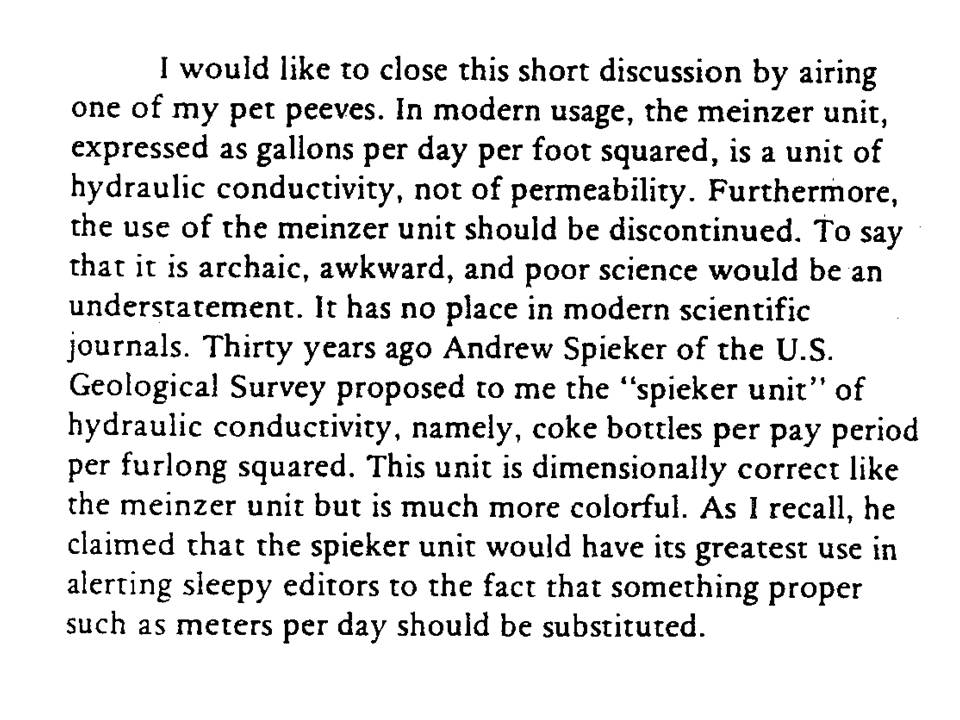
Anyway, a while back, I was rooting through some old literature and came across this response to a paper published in Ground Water (Correlations of permeability and grain size, R. G. Shepherd, Volume 27, No. 5, October 1989):
 I'll admit that I have never used the meinzer unit in any of my calculations. I've also avoided some of our other oddball units (acre-feet?). So there is hope that some of the more obscure units used in American hydrogeology will die out. Maybe in another 50 years we'll have converted to the metric system and not have to worry about all the contortions required to figure out how many gallons of water I need to pump out of a 5-inch borehole.
Anyway, a while back, I was rooting through some old literature and came across this response to a paper published in Ground Water (Correlations of permeability and grain size, R. G. Shepherd, Volume 27, No. 5, October 1989):
Thursday, February 10, 2011
new passport
Ok, I'm finally back to 100% - now I have energy to work, cook dinner, and have time for blogging!
So, I just got my new, renewed passport. Out of curiosity, I pulled out my old passports (I'm so glad they send them back!) and compared them. Boy, is my face puffier in my new one compared to my old one! Then again, the last passport is a fair bit older than 10 years old, so changes are inevitable. So how do all of them compare?
I got my first passport when I was a kid, when my father was traveling quite a bit for work and my parents had a reasonable expectation that he would be going overseas. That didn't happen, and in fact, he was laid off shortly after I got the passport. No stamps.
I got the second passport when I was in high school before I got braces. Holy buckteeth, batman! I actually did some international traveling on this passport, but unfortunately not all countries stamp passports (much to my chagrin at the time). Four stamps.
I got the third passport in college. I ended up with two visas, one of which was in order to live in another country. That visa got a constellation of overlapping stamps because I kept leaving that country for various reasons, and customs insisted on stamping the visa itself and not the 10 blank pages behind it. Sixteen stamps.
I put in for an opportunity to do more international traveling for work. We'll see if that pans out - although I don't want to have an entire career abroad, I wouldn't mind it for temporary postings. My goal is to have a minimum of 16 stamps... let's see how I do over the next ten years.
So, I just got my new, renewed passport. Out of curiosity, I pulled out my old passports (I'm so glad they send them back!) and compared them. Boy, is my face puffier in my new one compared to my old one! Then again, the last passport is a fair bit older than 10 years old, so changes are inevitable. So how do all of them compare?
I got my first passport when I was a kid, when my father was traveling quite a bit for work and my parents had a reasonable expectation that he would be going overseas. That didn't happen, and in fact, he was laid off shortly after I got the passport. No stamps.
I got the second passport when I was in high school before I got braces. Holy buckteeth, batman! I actually did some international traveling on this passport, but unfortunately not all countries stamp passports (much to my chagrin at the time). Four stamps.
I got the third passport in college. I ended up with two visas, one of which was in order to live in another country. That visa got a constellation of overlapping stamps because I kept leaving that country for various reasons, and customs insisted on stamping the visa itself and not the 10 blank pages behind it. Sixteen stamps.
I put in for an opportunity to do more international traveling for work. We'll see if that pans out - although I don't want to have an entire career abroad, I wouldn't mind it for temporary postings. My goal is to have a minimum of 16 stamps... let's see how I do over the next ten years.
Wednesday, November 17, 2010
following the jobs
Chris Rowan is moving to the US, following his 3rd postdoc. So congrats to Chris! He's moving to his third continent for work.
It would be really neat to live and work in different countries, in theory. But I don't really have the constitution for it, especially right now. I'm working a couple hundred miles from my home base, working in a job that was supposed to be a temporary step but is becoming permanent thanks to an utterly horrendous economy. I don't have any connections here, other than this job and my sweetie, and it's really, really lonely.
Maybe if I had a job I really enjoyed, using the science I got an advanced degree in, things would be different. But I can't imagine living any further from my support network than I already am.
It would be really neat to live and work in different countries, in theory. But I don't really have the constitution for it, especially right now. I'm working a couple hundred miles from my home base, working in a job that was supposed to be a temporary step but is becoming permanent thanks to an utterly horrendous economy. I don't have any connections here, other than this job and my sweetie, and it's really, really lonely.
Maybe if I had a job I really enjoyed, using the science I got an advanced degree in, things would be different. But I can't imagine living any further from my support network than I already am.
Friday, May 8, 2009
losing my accent
I spent my formative years surrounded by people who had a distinctive way of speaking. My own accent was never particularly strong, but I knew folks who were incomprehensible to outsiders. I have a certain fondness for this way of speaking, even though it has certain negative associations.
So then I went away to grad school in a place where the locals had an equally distinctive accent (but distinct in a completely different way). I spent my first couple months inwardly giggling at everybody around me, but before I knew it, I had picked up this additional accent. At the same time, in some sort of subconscious rebellion against the new accent, my original accent got a lot stronger.
Now I have what has been called charitably a "lilt". I have ceased making fun of celebrities with odd or fake sounding accents (e.g. Madonna), because I sound sort of silly myself.
So then I went away to grad school in a place where the locals had an equally distinctive accent (but distinct in a completely different way). I spent my first couple months inwardly giggling at everybody around me, but before I knew it, I had picked up this additional accent. At the same time, in some sort of subconscious rebellion against the new accent, my original accent got a lot stronger.
Now I have what has been called charitably a "lilt". I have ceased making fun of celebrities with odd or fake sounding accents (e.g. Madonna), because I sound sort of silly myself.
Thursday, February 12, 2009
unit conversion
My department has lots of international grad students, and they’re all boggled by our strange units of measurement. Inches? Yards? Fluid ounces? Acre-feet?
The metric system is so nice. When you’re working with contaminants, you work on lots of different scales and they’re a cinch to convert. 1 m3 = 1000 L; 1 L = 1000 cm3 (mL), etc etc.
And then you start doing fieldwork, where you have a horrible mishmash of units. For example, you often need to remove x well volumes of water. And you’ve got a 5 gallon bucket to measure your water volume and dump into a 55-gallon drum. And how do you measure flow? In mL/minute! Then you’ve got a well that’s 2 inches in diameter, and has x feet of water in it (measured in tenths of a foot, rather than inches, of course – the need to find measuring tapes/rulers scaled in 10ths of a foot is another pain). Back of the envelope-y calculations are fine, so you start figuring, ok, it has a 1 inch radius, so if you convert it to cm, then square it, then, multiply it by 3.14, then, um…
So you do all the conversions, and if you have a standard 2-inch well, then each foot of water is 0.16 gallons (I think…it’s been a while). Ok, that’s doable, right? And then you find that your site has some odd 1.25 inch temporary wells and then you start calculating all over again.
That’s why there’s always a cheap calculator in my toolkit, along with everything else.
The metric system is so nice. When you’re working with contaminants, you work on lots of different scales and they’re a cinch to convert. 1 m3 = 1000 L; 1 L = 1000 cm3 (mL), etc etc.
And then you start doing fieldwork, where you have a horrible mishmash of units. For example, you often need to remove x well volumes of water. And you’ve got a 5 gallon bucket to measure your water volume and dump into a 55-gallon drum. And how do you measure flow? In mL/minute! Then you’ve got a well that’s 2 inches in diameter, and has x feet of water in it (measured in tenths of a foot, rather than inches, of course – the need to find measuring tapes/rulers scaled in 10ths of a foot is another pain). Back of the envelope-y calculations are fine, so you start figuring, ok, it has a 1 inch radius, so if you convert it to cm, then square it, then, multiply it by 3.14, then, um…
So you do all the conversions, and if you have a standard 2-inch well, then each foot of water is 0.16 gallons (I think…it’s been a while). Ok, that’s doable, right? And then you find that your site has some odd 1.25 inch temporary wells and then you start calculating all over again.
That’s why there’s always a cheap calculator in my toolkit, along with everything else.
Tuesday, November 18, 2008
STEM opportunities
Every once in a while, I read some article about the ratio of international students: domestic students in STEM schools. If the general public can comment on the article, you usually get a lot of rants about how international students are stealing opportunities from domestic students.
Here's the thing: in a lot of these departments they can't find enough American students to fill the openings. I'm familiar with one engineering department that didn't have a single non-international grad student in the entering class for the next year. They're desperate for Americans because, frankly, those statistics look really bad. And they want to educate Americans. But trying to get an engineer in this discipline in for a masters or PhD is nigh impossible because they can earn tons of money right off the bat, without going to grad school. Same thing for a lot of math and computer science departments.
We don't live in a vacuum. Everybody wants the US to keep its technological superiority. And to do that, you have to compete with a lot of upstart well funded universities. If we aren't raising the numbers of scientists and engineers we need ourselves, we're going to have to take the best and the brightest from the rest of the world.
I do think we have a culture against STEM education - the popular conception is that all STEM folks are hopelessly nerdy white males, and smart, ambitious people people here tend to gravitate toward better paying and more culturally accepted work. We do need to improve the STEM pipeline, but in the meantime we're going to have to supplement with non-Americans to keep our competitive edge.
I think international students are a net positive for grad schools in other ways, but that's another post.
Here's the thing: in a lot of these departments they can't find enough American students to fill the openings. I'm familiar with one engineering department that didn't have a single non-international grad student in the entering class for the next year. They're desperate for Americans because, frankly, those statistics look really bad. And they want to educate Americans. But trying to get an engineer in this discipline in for a masters or PhD is nigh impossible because they can earn tons of money right off the bat, without going to grad school. Same thing for a lot of math and computer science departments.
We don't live in a vacuum. Everybody wants the US to keep its technological superiority. And to do that, you have to compete with a lot of upstart well funded universities. If we aren't raising the numbers of scientists and engineers we need ourselves, we're going to have to take the best and the brightest from the rest of the world.
I do think we have a culture against STEM education - the popular conception is that all STEM folks are hopelessly nerdy white males, and smart, ambitious people people here tend to gravitate toward better paying and more culturally accepted work. We do need to improve the STEM pipeline, but in the meantime we're going to have to supplement with non-Americans to keep our competitive edge.
I think international students are a net positive for grad schools in other ways, but that's another post.
Friday, August 8, 2008
international communication
As a grad student at a STEM school, I work and study alongside students from every corner of the world who have English skills ranging from perfect with an adorable accent (New Zealand!) down to "how did they pass the TOEFL!?".
My school is located a significant distance from where I was previously living. Since I was only staying for a couple of years, I left most of my stuff in storage and moved into (furnished) graduate housing. Grad student housing is generally reserved for non-local students and is probably about 75% international. My first 3 roomates and I were from four continents, so I lived with non-native English speakers as well.
Growing up, verbal communication was fairly low on my list of interests and/or abilities. I tended to mumble, and as a massive geek/bookworm, I had a vocabulary larger than most adults. Even in college, I was accused of using too many big words. Working as a consultant took care of the mumbling in short order. But I have to admit to still using big words. Certain terms have a very specific conotation and I prefer to direct my speaking and writing so that it is exactly what I mean.
Now that I have long conversations with friends with varying English abilities, I've become adept at simplifying my language and using lots of gestures. (gar! more big words!) I've also had lots of practice describing things in a different way if someone stalls out on a particular concept. I tend to emote more when talking to non-native English speakers so that if someone misses the words, they still get what I'm trying to say. I do try to avoid seeming condescending. The folks I talk to are highly intelligent and knowledgeable - we just have to figure out a way to keep our languages from interfering with what we want to say.
My school is located a significant distance from where I was previously living. Since I was only staying for a couple of years, I left most of my stuff in storage and moved into (furnished) graduate housing. Grad student housing is generally reserved for non-local students and is probably about 75% international. My first 3 roomates and I were from four continents, so I lived with non-native English speakers as well.
Growing up, verbal communication was fairly low on my list of interests and/or abilities. I tended to mumble, and as a massive geek/bookworm, I had a vocabulary larger than most adults. Even in college, I was accused of using too many big words. Working as a consultant took care of the mumbling in short order. But I have to admit to still using big words. Certain terms have a very specific conotation and I prefer to direct my speaking and writing so that it is exactly what I mean.
Now that I have long conversations with friends with varying English abilities, I've become adept at simplifying my language and using lots of gestures. (gar! more big words!) I've also had lots of practice describing things in a different way if someone stalls out on a particular concept. I tend to emote more when talking to non-native English speakers so that if someone misses the words, they still get what I'm trying to say. I do try to avoid seeming condescending. The folks I talk to are highly intelligent and knowledgeable - we just have to figure out a way to keep our languages from interfering with what we want to say.
Subscribe to:
Posts (Atom)


