I got a good question on this post regarding the transition from office to field attire in the same day. Guys have it easy in this respect because even if they work in a formal environment, they can just wear khakis to work and then lose the tie/roll up the sleeves and not look ridiculous if they have to run out to do something "clean" in the field (grab some equipment, meet someone, etc).
I have to admit that when I'm in this situation (and it comes up relatively frequently in my case, because I run out to meet clients or regulators on site walks/inspections/technical reviews), I dress kind of like a guy for the day. I am not at all a polo wearer normally, but I do have some company branded polos that fit ok and don't look sloppy untucked (nothing looks right tucked in for me), and I have a pair of boot-cut khakis that fit over steel-toe boots. The khakis are from Gap (from like 10 years ago so they're totally out of fashion) and they're more of an office style than a "jeans" style (flat pockets, a bit drapey, etc), so they're more formal than just jeans. If it's cold out, then I can wear a nice office appropriate top, because if I'm in the field I'm going to wear a jacket anyway.This is going to sound kind of silly, but last time I needed to buy
steel-toe boots, I deliberately picked a pair that were dark brown and
had kind of a nice finish so that they went well with khakis.
I actually work in a relatively formal office, but the corporate branded polo (or cardigan) + khakis or dark jeans says "I would not dress like this normally, but I am going to a site". If the office is very formal, one could wear steel-toe boots with this the whole day (ugh. who wants to wear their boots more than absolutely necessary) to give the impression "I am just here briefly before I do fieldwork". Even in a formal office, an environmental consulting firm will an exception for people who are running to the field.
Showing posts with label gear. Show all posts
Showing posts with label gear. Show all posts
Monday, July 23, 2018


Wednesday, January 24, 2018
field clothing closet
I have recently moved to a new place, and now I finally have adequate closet space for all of my clothing (fieldwork, office, casual, fancy)! I also inherited closet organization systems that I have no interest in changing or upgrading.
So here's how I've organized it:
Full-size closet #1 (field gear):
1. top shelf: field sweaters, hats, and non-bib style coveralls
2. 2nd shelf: bandanas, lightweight pants
3. 3rd shelf: bras, socks, mid-weight pants (like regular carhartts)
4. hangers underneath 3rd shelf: all the shirts. So many shirts. long-sleeve tees acceptable as outerwear, long-sleeved underlayers, short-sleeve tees acceptable as outerwear, short-sleeve tees only acceptable as undershirts...
5. hangers with more space beneath: all outerwear (pants, tops) and jacket-like items (vests, fleeces)
6. floor: everything else that I don't really use and bib-style coveralls on top of/in field duffel bags
Hall closet
Non field coats, hats, gloves, miscellaneous sporting items (snowshoes, trekking poles, skates, etc)
Little closet (regular clothing):
I took this one over so I could get ready for work without disturbing my sweetie. It has almost all of my standard office and hanging around stuff, including underwear, socks, etc, with a few exceptions that are in...
Full-size closet #2 (formal stuff and miscellany):
Jeans (because I ran out of room in the little bedroom closet), pajamas, all the shoes that aren't in the pile close to the front door, suits, skirts, dresses, and my sweetie's entire wardrobe.
I remember squashing most of this stuff into a single closet and under the bed when I was in grad school, and I am so glad I don't have to do that any more.
So here's how I've organized it:
Full-size closet #1 (field gear):
1. top shelf: field sweaters, hats, and non-bib style coveralls
2. 2nd shelf: bandanas, lightweight pants
3. 3rd shelf: bras, socks, mid-weight pants (like regular carhartts)
4. hangers underneath 3rd shelf: all the shirts. So many shirts. long-sleeve tees acceptable as outerwear, long-sleeved underlayers, short-sleeve tees acceptable as outerwear, short-sleeve tees only acceptable as undershirts...
5. hangers with more space beneath: all outerwear (pants, tops) and jacket-like items (vests, fleeces)
6. floor: everything else that I don't really use and bib-style coveralls on top of/in field duffel bags
Hall closet
Non field coats, hats, gloves, miscellaneous sporting items (snowshoes, trekking poles, skates, etc)
Little closet (regular clothing):
I took this one over so I could get ready for work without disturbing my sweetie. It has almost all of my standard office and hanging around stuff, including underwear, socks, etc, with a few exceptions that are in...
Full-size closet #2 (formal stuff and miscellany):
Jeans (because I ran out of room in the little bedroom closet), pajamas, all the shoes that aren't in the pile close to the front door, suits, skirts, dresses, and my sweetie's entire wardrobe.
I remember squashing most of this stuff into a single closet and under the bed when I was in grad school, and I am so glad I don't have to do that any more.
Tuesday, December 6, 2016
cold weather skin
I am prone to dry skin. My face is extremely sensitive, which means I come in looking sandblasted when it's cold or windy. So I moisturize and use barrier creams and super hydrating lip balm and douse myself with sunscreen in the hopes that I don't slough off most of my face after a long day in the field.
Now that I'm older, I have a new problem. My eyelids.
My eyelids have gotten that crepe-y texture reminiscent of someone with eyes... much older than mine. And they recently started cracking in the cold.
What do I do about my eyelids once they've cracked? I must have tried every super moisturizer on the market, and they uniformly say "not for broken skin" in addition to "not for the eye area". I've been slathering them with non-medicated (non-mentholated) lip balm before going out, under the theory that if they're ok for lips, they're ok for eyes.
Do you run into this problem, and if so, what works for you?
Now that I'm older, I have a new problem. My eyelids.
My eyelids have gotten that crepe-y texture reminiscent of someone with eyes... much older than mine. And they recently started cracking in the cold.
What do I do about my eyelids once they've cracked? I must have tried every super moisturizer on the market, and they uniformly say "not for broken skin" in addition to "not for the eye area". I've been slathering them with non-medicated (non-mentholated) lip balm before going out, under the theory that if they're ok for lips, they're ok for eyes.
Do you run into this problem, and if so, what works for you?
Wednesday, November 30, 2016
frac tank berms
This will be the week of frac tanks.
I complained about frac tanks in this post, but I wanted to mention something specific to those 21,000-gallon tanks that I find ridiculous and technically dumb: the berms you can rent.
So, if you have a very particular client or sensitive site, they may want the frac tank to have a berm around it. These can be rented along with the frac tank. Example below from here:
 This doesn't have a frac tank inside it, but it's the same thing that I've rented in the past.
A few notes:
1. The berm is made of reasonably thick stuff, but it's not all that strong. If renting one, you are just as likely to get a beat-up old thing with pinholes everywhere. You can make the delivery person spend ages patching it with chemicals (probably not good for your chemical evaluation/inventory) or heat-sealing with open flame (also a problem for many sites) or make a stink and get them to deliver another. Even if you get a pristine berm, the action of backing a 21,000-gallon tank over it (whether it's on pavement or gravel), lowering the tank, and inevitably scraping the bottom along the ground will put new holes in it.
2. Say the delivery person did not make a hash of the berm/tank placement. Note the relative amount of water in the tank vs. the amount in the berm (less than a foot). This is not appropriate for anything except very incidental spills during filling. The kind you could eliminate by just draping some poly sheeting around as needed. Also, if you've parked the thing on any sort of slope, you'll lose a big chunk of the already-limited storage capacity.
3. What the berm is very good at is collecting rainwater, especially in a reasonably moist climate like most of the east coast. So you'll leave it alone for a while (for example, while you're waiting for your wastewater characterization) and then a regulatory person or adversarial inspector drops by and it's a crisis because "the tank is leaking!". You could eliminate the rainwater issue by stepping on the edge and letting the excess water out, but to say that's bad optics is an understatement. So you end up pumping that rainwater into the tank, causing premature filling and unnecessary dilution.
One way to minimize rainwater collection is to pull out the L-shaped supports (you can see them as metallic glints in the picture above) and flatten the thing until you're actually going to start slopping water around. But those supports aren't actually all that easy to pull out, especially close to the sides of the berm. Far better to just tuck in some poly sheeting and maybe some spill pads as needed and then gather them up as you finish.
As far as I can tell, frac tank berms are an excellent example of "optical remediation" - they're functionally useless, but they make decision makers feel like they're being extra clean and careful. Far better to use actual good housekeeping to keep a site clean, but that doesn't look as good on the check box, I guess.
I complained about frac tanks in this post, but I wanted to mention something specific to those 21,000-gallon tanks that I find ridiculous and technically dumb: the berms you can rent.
So, if you have a very particular client or sensitive site, they may want the frac tank to have a berm around it. These can be rented along with the frac tank. Example below from here:

A few notes:
1. The berm is made of reasonably thick stuff, but it's not all that strong. If renting one, you are just as likely to get a beat-up old thing with pinholes everywhere. You can make the delivery person spend ages patching it with chemicals (probably not good for your chemical evaluation/inventory) or heat-sealing with open flame (also a problem for many sites) or make a stink and get them to deliver another. Even if you get a pristine berm, the action of backing a 21,000-gallon tank over it (whether it's on pavement or gravel), lowering the tank, and inevitably scraping the bottom along the ground will put new holes in it.
2. Say the delivery person did not make a hash of the berm/tank placement. Note the relative amount of water in the tank vs. the amount in the berm (less than a foot). This is not appropriate for anything except very incidental spills during filling. The kind you could eliminate by just draping some poly sheeting around as needed. Also, if you've parked the thing on any sort of slope, you'll lose a big chunk of the already-limited storage capacity.
3. What the berm is very good at is collecting rainwater, especially in a reasonably moist climate like most of the east coast. So you'll leave it alone for a while (for example, while you're waiting for your wastewater characterization) and then a regulatory person or adversarial inspector drops by and it's a crisis because "the tank is leaking!". You could eliminate the rainwater issue by stepping on the edge and letting the excess water out, but to say that's bad optics is an understatement. So you end up pumping that rainwater into the tank, causing premature filling and unnecessary dilution.
One way to minimize rainwater collection is to pull out the L-shaped supports (you can see them as metallic glints in the picture above) and flatten the thing until you're actually going to start slopping water around. But those supports aren't actually all that easy to pull out, especially close to the sides of the berm. Far better to just tuck in some poly sheeting and maybe some spill pads as needed and then gather them up as you finish.
As far as I can tell, frac tank berms are an excellent example of "optical remediation" - they're functionally useless, but they make decision makers feel like they're being extra clean and careful. Far better to use actual good housekeeping to keep a site clean, but that doesn't look as good on the check box, I guess.
Friday, November 4, 2016
Frac tank logistics
I had a good couple questions on my last post, and once my response in the comments reached two paragraphs, I thought it would be better to split it out into a separate post.
So, how do I clean frac tanks, and why do I worry about cleaning them, instead of the person I rented them from? And if I clean frac tanks, do I have a death spiral of cleaning ever smaller containers? (...paraphrasing)
So, the frac tank company rents out tanks to everybody. You see them by the side of the highway and on big construction sites for clean water storage. I arrange for them to store water contaminated with all sorts of stuff, although usually not with hair-raising concentrations (those get segregated separately as hazardous waste, and usually end up in smaller containers, like drums). I've also used them to store exotic mixtures of water + stuff to treat contamination, like oxidants and nutrients for bioaugmentation (feed bugs that break down contamination). The frac tank company is not expert in oily water or treatment chemicals or random contamination. So they require that the tanks be returned clean. I admit that I have not previously worried about how clean they were upon arrival to the site, because honestly, by the time you get to 21,000 gallons, that's a heck of a lot of dilution.
I always arrange for a transportation and disposal contractor to get my investigation-derived waste (IDW) off-site and to do the tank cleaning. And I usually have them deal with the tank/roll-off rental (for a modest mark-up, of course), because then it's their responsibility to clean the containers sufficiently that they'll get be accepted back.
When we're developing wells (removing fines!) or drilling, we'll always end up with sediment in the water. And we can arrange for bag filters and secondary settlement tanks and all that, but we'll inevitably end up with at least some gunk on the bottom of the containers. So the IDW contractor, who has all the appropriate certifications and equipment to go traipsing around inside contaminated tanks, takes a power washer to it and gets all the gunk out. Usually someone is standing by to suction the water+gunk into a drum. And since the water that was in the tank has been characterized and accepted for disposal (which is why the tank is empty now), the wash water is the same stuff, only diluted, and it goes off to wherever the rest of the water went. The drums get recycled (washed out, worst of the dents banged out, cooked, maybe get a new coat of paint) and then off they go to the next drilling job.
When I first started out, it was a bit of a surprise how much time was spent on things like cleaning tanks compared to science. But that's the environmental consulting business - science is fine, but a big part of the job is logistics.
So, how do I clean frac tanks, and why do I worry about cleaning them, instead of the person I rented them from? And if I clean frac tanks, do I have a death spiral of cleaning ever smaller containers? (...paraphrasing)
So, the frac tank company rents out tanks to everybody. You see them by the side of the highway and on big construction sites for clean water storage. I arrange for them to store water contaminated with all sorts of stuff, although usually not with hair-raising concentrations (those get segregated separately as hazardous waste, and usually end up in smaller containers, like drums). I've also used them to store exotic mixtures of water + stuff to treat contamination, like oxidants and nutrients for bioaugmentation (feed bugs that break down contamination). The frac tank company is not expert in oily water or treatment chemicals or random contamination. So they require that the tanks be returned clean. I admit that I have not previously worried about how clean they were upon arrival to the site, because honestly, by the time you get to 21,000 gallons, that's a heck of a lot of dilution.
I always arrange for a transportation and disposal contractor to get my investigation-derived waste (IDW) off-site and to do the tank cleaning. And I usually have them deal with the tank/roll-off rental (for a modest mark-up, of course), because then it's their responsibility to clean the containers sufficiently that they'll get be accepted back.
When we're developing wells (removing fines!) or drilling, we'll always end up with sediment in the water. And we can arrange for bag filters and secondary settlement tanks and all that, but we'll inevitably end up with at least some gunk on the bottom of the containers. So the IDW contractor, who has all the appropriate certifications and equipment to go traipsing around inside contaminated tanks, takes a power washer to it and gets all the gunk out. Usually someone is standing by to suction the water+gunk into a drum. And since the water that was in the tank has been characterized and accepted for disposal (which is why the tank is empty now), the wash water is the same stuff, only diluted, and it goes off to wherever the rest of the water went. The drums get recycled (washed out, worst of the dents banged out, cooked, maybe get a new coat of paint) and then off they go to the next drilling job.
When I first started out, it was a bit of a surprise how much time was spent on things like cleaning tanks compared to science. But that's the environmental consulting business - science is fine, but a big part of the job is logistics.
Wednesday, November 2, 2016
liquid waste storage
This is the natural follow-up to my previous post on solid waste storage.
We tend to keep our liquid investigation-derived waste (IDW) in either 55-gallon drums, poly tanks, or gigantic frac tanks.
Drums for liquids are the same as drums for solids, as discussed earlier. They're easy to drive around and pump off if needed, but troublesome if you're dealing with more than a couple hundred gallons.
I usually prefer poly (plastic) tanks, which range up in size from 150 gallons or so (about the maximum that you can put in a full-size pickup) up to a couple thousand gallons. The poly tanks tend to be much easier to open/close (which you may do often if you're just filling them a couple of buckets at a time) but still hold enough water to be useful for larger jobs. Also, if you have mildly corrosive water or treatment chemicals, these hold up better than the steel drums. About my preferred size (225 gallon) example here from ebay:

If I have a very large water sampling job, or an intermediate-sized drilling job, I may go with a much larger poly tank (this from rain for rent):
 I've used these quite a bit - they vary in size (this one is almost 5,000 gallons, so on the larger end). The taller ones get a bit precarious to climb up. They have a top cap you can easily spin to open/close, and they have discharge connections at the bottom so that they don't need to be entered to be cleaned - you just need to aim a power washer or steam cleaner at the sides and empty from the bottom. Staff who are doing heavy-duty water handling can also directly connect to the bottom rather than dragging a hose to the top.
But sometimes, you find yourself handling lots of water. After a certain point, you'll need a frac tank. The biggest standard tank is 21,000 gallons, and if you're going to be doing a lot of deep drilling or potentially exciting drilling (karst? faults?) and need to containerize the water for disposal, you may get a couple of these (from Adler):
 Oh boy. Frac tanks. I have strong opinions about these. If you need them, you need them. But what a pain. They need, like, acres of space to be dropped off. You need to perform confined-space entry to clean them. And I'm always paranoid that some local troublemaker is going to go ahead and open the front porthole (halfway up the face on the right in the photo) when the thing is mostly full and we'll have A Big Problem. Although I will admit that if I need a nice "quasi-aerial" photograph of a busy environmental investigation, the top of a 21,000-gallon tank is the perfect place to stand.
I'm sure that my counterparts in the oil and gas biz think that my frac tanks are hilariously small (they think the same of the drill rigs I use), compared to the manmade lagoons that they might make for a fracking project. But this is as big as it gets for me, thank goodness. I have a hard enough time keeping them properly sealed and secured.
We tend to keep our liquid investigation-derived waste (IDW) in either 55-gallon drums, poly tanks, or gigantic frac tanks.
Drums for liquids are the same as drums for solids, as discussed earlier. They're easy to drive around and pump off if needed, but troublesome if you're dealing with more than a couple hundred gallons.
I usually prefer poly (plastic) tanks, which range up in size from 150 gallons or so (about the maximum that you can put in a full-size pickup) up to a couple thousand gallons. The poly tanks tend to be much easier to open/close (which you may do often if you're just filling them a couple of buckets at a time) but still hold enough water to be useful for larger jobs. Also, if you have mildly corrosive water or treatment chemicals, these hold up better than the steel drums. About my preferred size (225 gallon) example here from ebay:
If I have a very large water sampling job, or an intermediate-sized drilling job, I may go with a much larger poly tank (this from rain for rent):

But sometimes, you find yourself handling lots of water. After a certain point, you'll need a frac tank. The biggest standard tank is 21,000 gallons, and if you're going to be doing a lot of deep drilling or potentially exciting drilling (karst? faults?) and need to containerize the water for disposal, you may get a couple of these (from Adler):

I'm sure that my counterparts in the oil and gas biz think that my frac tanks are hilariously small (they think the same of the drill rigs I use), compared to the manmade lagoons that they might make for a fracking project. But this is as big as it gets for me, thank goodness. I have a hard enough time keeping them properly sealed and secured.
Friday, October 28, 2016
solid waste storage
So how do we actually handle and store the investigation-derived waste (IDW) that I mentioned in my previous post? I got a little carried away when I started writing, so for this one, I'll just focus on soil.
For big excavations, soil gets stockpiled (hopefully on plastic sheeting, and then covered) prior to disposal. But as a geologist, I don't usually have to personally manage stockpiles. My stock in trade is usually drums and roll-off containers.
55-gallon drums are the easiest to handle - I can hoist around empty drums myself, and my contractor (usually the drilling crew or a separate disposal/waste handling crew) should have equipment to safely move filled drums. This does not mean hanging a mostly full drum off the mast and letting it swing freely as the drill rig moves to the next location, by the way. However, once you get beyond a couple hundred gallons of soil or water, managing drum storage can get complicated fast. Also, the aesthetics of a drum farm are terrible. This is the classic:

Ah, so many fond memories of cranking the bolts open and closed again and again to add more stuff, sample, figure out what was in there after the label rubbed off... And then, after they've been banged around a while and start to rust, the ring and lid get harder and harder to open and close, and you end up beating on them with a hammer to get them to cooperate.
So we often use open roll-off containers. These are good for big jobs, especially if we're drilling large boreholes and are expecting large volumes of soil and/or water. However, the roll-offs need lots of space to maneuver for drop off and pickup, and each lid is its own special snowflake (protip: never let the transporter leave without having him demonstrate how to operate the lid, and if it looks sketchy, refuse delivery. You don't want to fill the thing halfway and realize you can't open the other side), and if these suckers get too wet or too full, you've got to figure out how to either solidify them so they don't slop out the back when lifted, or scoop enough stuff back out of them again. Example in mid-drop off below (from wikipedia). Note the lifting angle.

How does one solidify an overly sloppy roll-off? Well, you can wait for the solids to settle and try draining the free liquid. If you have some extra well screen, you can poke that in there before you get any real accumulation and fill around it. Stick a pump in the screen and remove as much water as you can. It probably won't be much. You can borrow extra materials the drillers left - bentonite clay, sand, and road-building gravel - to try and give the slop enough structure that the roll-off can be lifted. Or, find a local farm supply place and buy a couple bags of wood shavings.
The main thing, though, is to keep your solids dry and secure, regardless of whether you're keeping them in a 5-gallon bucket or a 40-yard roll-off.
For big excavations, soil gets stockpiled (hopefully on plastic sheeting, and then covered) prior to disposal. But as a geologist, I don't usually have to personally manage stockpiles. My stock in trade is usually drums and roll-off containers.
55-gallon drums are the easiest to handle - I can hoist around empty drums myself, and my contractor (usually the drilling crew or a separate disposal/waste handling crew) should have equipment to safely move filled drums. This does not mean hanging a mostly full drum off the mast and letting it swing freely as the drill rig moves to the next location, by the way. However, once you get beyond a couple hundred gallons of soil or water, managing drum storage can get complicated fast. Also, the aesthetics of a drum farm are terrible. This is the classic:

Ah, so many fond memories of cranking the bolts open and closed again and again to add more stuff, sample, figure out what was in there after the label rubbed off... And then, after they've been banged around a while and start to rust, the ring and lid get harder and harder to open and close, and you end up beating on them with a hammer to get them to cooperate.
So we often use open roll-off containers. These are good for big jobs, especially if we're drilling large boreholes and are expecting large volumes of soil and/or water. However, the roll-offs need lots of space to maneuver for drop off and pickup, and each lid is its own special snowflake (protip: never let the transporter leave without having him demonstrate how to operate the lid, and if it looks sketchy, refuse delivery. You don't want to fill the thing halfway and realize you can't open the other side), and if these suckers get too wet or too full, you've got to figure out how to either solidify them so they don't slop out the back when lifted, or scoop enough stuff back out of them again. Example in mid-drop off below (from wikipedia). Note the lifting angle.

How does one solidify an overly sloppy roll-off? Well, you can wait for the solids to settle and try draining the free liquid. If you have some extra well screen, you can poke that in there before you get any real accumulation and fill around it. Stick a pump in the screen and remove as much water as you can. It probably won't be much. You can borrow extra materials the drillers left - bentonite clay, sand, and road-building gravel - to try and give the slop enough structure that the roll-off can be lifted. Or, find a local farm supply place and buy a couple bags of wood shavings.
The main thing, though, is to keep your solids dry and secure, regardless of whether you're keeping them in a 5-gallon bucket or a 40-yard roll-off.
Tuesday, October 18, 2016
field branding
If you are are in the environmental biz, how important is it for you to wear "branded" field clothing?
This has varied considerably in my experience. I've worked at places where all of your PPE (personal protective equipment) had to have the correct logo, but nothing else mattered; places where essentially all of your clothing and PPE had to have the logo; and places where not only did management not shell out for branded stuff, but if you somehow acquired and wore something with the organization's logo, you were looked down on as sort of a management shill.
Most of my skilled labor contractors (excavation/construction, drillers, waste disposal) wear all company-branded stuff all the time: hard hat, safety vest, shirts (from button-downs to summer t-shirts to sweatshirts) and jackets. Most of the consultants I know will have the logo on at least safety vests, because they're generally cheap, interchangeable, and easy to put a logo on. Many of the specialty firms I've worked with don't seem to have any branded stuff.
Using company-branded stuff is convenient if it means that you don't have to buy/maintain stuff that you wouldn't otherwise wear. But the problem is when you're not a standard size, or you need stuff with better performance than whatever is being handed out. For example, I'll happily wear the corporate t-shirts. But when you're a lady with short arms and you need some more technical gear for cold/rain/strenuous activity, getting corporate stuff that actually fits is a bit of a crapshoot. When I have worked for institutions that required logos for all field gear, I did what I could. But once the weather became beastly, all bets were off. I wasn't going to get hypothermia over a logo.
This has varied considerably in my experience. I've worked at places where all of your PPE (personal protective equipment) had to have the correct logo, but nothing else mattered; places where essentially all of your clothing and PPE had to have the logo; and places where not only did management not shell out for branded stuff, but if you somehow acquired and wore something with the organization's logo, you were looked down on as sort of a management shill.
Most of my skilled labor contractors (excavation/construction, drillers, waste disposal) wear all company-branded stuff all the time: hard hat, safety vest, shirts (from button-downs to summer t-shirts to sweatshirts) and jackets. Most of the consultants I know will have the logo on at least safety vests, because they're generally cheap, interchangeable, and easy to put a logo on. Many of the specialty firms I've worked with don't seem to have any branded stuff.
Using company-branded stuff is convenient if it means that you don't have to buy/maintain stuff that you wouldn't otherwise wear. But the problem is when you're not a standard size, or you need stuff with better performance than whatever is being handed out. For example, I'll happily wear the corporate t-shirts. But when you're a lady with short arms and you need some more technical gear for cold/rain/strenuous activity, getting corporate stuff that actually fits is a bit of a crapshoot. When I have worked for institutions that required logos for all field gear, I did what I could. But once the weather became beastly, all bets were off. I wasn't going to get hypothermia over a logo.
Monday, October 3, 2016
tablet redux
I was looking back through my paltry list of blog posts this year, and the post on smartphones reminded me of this post regarding tablet usage in the field.
It's amazing what a difference a few years makes.
Environmental consulting always seems to run on tiny margins. I've worked for multiple organizations, and I've never had access to the newest and shiniest things. We only get technology if we can make a strong business case for it, and often it seems to be that a business case is "geez, it seems like everyone else has it, and now the clients expect it." I wasn't surprised to see that the exploration folks were using tablets before us.
But by now, all of the field people I know either have their own tablets assigned, or have access to a generous pool of them. Tablets are cheap, durable, and small enough that they can replace most paper forms and ancillary equipment, and it's becoming much easier to input data (photographs, field notes, calculations) or to have our instruments log data and send to our tablets automatically. Once collected, that data can be sent back to the field team leader so that the investigation is managed in real time - far easier and less time-consuming than poring over a pile of papers after the field staff have finished for the day. If a piece of equipment is misbehaving or we're getting strange results, it's easy to send data or photos/videos immediately, so that the project technical/management folks can adjust the project as needed.
I don't see the fundamental activities of fieldwork changing with technology, though. Regardless of how much we automate, there are certain tasks inherent to fieldwork: sending out people to troubleshoot, collect samples, shoo away destructive wildlife/curious passerby, and observe details that would be otherwise missed. And there are tasks inherent to keeping staff safe, accounted for, and working toward the correct goal. Regardless of how we collect data, we'll still need to meet and coordinate in a shared space regularly to make sure that the project is on track, that project roles are understood, and that everyone is ok.
It's amazing what a difference a few years makes.
Environmental consulting always seems to run on tiny margins. I've worked for multiple organizations, and I've never had access to the newest and shiniest things. We only get technology if we can make a strong business case for it, and often it seems to be that a business case is "geez, it seems like everyone else has it, and now the clients expect it." I wasn't surprised to see that the exploration folks were using tablets before us.
But by now, all of the field people I know either have their own tablets assigned, or have access to a generous pool of them. Tablets are cheap, durable, and small enough that they can replace most paper forms and ancillary equipment, and it's becoming much easier to input data (photographs, field notes, calculations) or to have our instruments log data and send to our tablets automatically. Once collected, that data can be sent back to the field team leader so that the investigation is managed in real time - far easier and less time-consuming than poring over a pile of papers after the field staff have finished for the day. If a piece of equipment is misbehaving or we're getting strange results, it's easy to send data or photos/videos immediately, so that the project technical/management folks can adjust the project as needed.
I don't see the fundamental activities of fieldwork changing with technology, though. Regardless of how much we automate, there are certain tasks inherent to fieldwork: sending out people to troubleshoot, collect samples, shoo away destructive wildlife/curious passerby, and observe details that would be otherwise missed. And there are tasks inherent to keeping staff safe, accounted for, and working toward the correct goal. Regardless of how we collect data, we'll still need to meet and coordinate in a shared space regularly to make sure that the project is on track, that project roles are understood, and that everyone is ok.
Monday, January 25, 2016
smartphones in the field
I've admitted that I am a luddite (really, just a cynic about the brightest, flashiest new thing) here and here and...
It will come as no surprise that I was an extremely late smartphone adopter. I was essentially forced to get a smartphone because I was running field projects and it became untenable to not receive and respond to e-mails immediately. Running back to the trailer a couple times a day to refresh the laptop's e-mail wasn't working anymore.
Everyone around me swore that my smartphone would be life-changing. And I do use several functions in the field: the stopwatch. The calculator (although my dumbphone also had a perfectly adequate calculator). The alarm clock, with its ability to set different times for different days. The ability to text reasonably quickly. E-mail and internet. In a pinch, navigation and camera, although I have dedicated gadgets that work much better.
I haven't really added any applications, although I probably should invest in a few that would be especially handy: a flashlight (I've got a pretty good one on my keychain already), a magnetic detector/stud finder (although I don't think it's very sensitive), and a more accurate location finder/compass. I've focused most of my efforts into getting a bulletproof, water resistant phone with a good battery, so that it will survive tough conditions even if it's not very high-powered.
I do have to watch (in myself and in others) that smartphone doesn't become all-consuming. Just because you can browse the internet while you're supposed to be overseeing a subcontractor doesn't mean you should. And just because you get e-mails fired off from a bunch of night owls doesn't mean that you should feel compelled to respond at all hours, either. I really try to be on when I'm supposed to be and off when I can be, but the smartphone makes it easier to blur those lines.
It will come as no surprise that I was an extremely late smartphone adopter. I was essentially forced to get a smartphone because I was running field projects and it became untenable to not receive and respond to e-mails immediately. Running back to the trailer a couple times a day to refresh the laptop's e-mail wasn't working anymore.
Everyone around me swore that my smartphone would be life-changing. And I do use several functions in the field: the stopwatch. The calculator (although my dumbphone also had a perfectly adequate calculator). The alarm clock, with its ability to set different times for different days. The ability to text reasonably quickly. E-mail and internet. In a pinch, navigation and camera, although I have dedicated gadgets that work much better.
I haven't really added any applications, although I probably should invest in a few that would be especially handy: a flashlight (I've got a pretty good one on my keychain already), a magnetic detector/stud finder (although I don't think it's very sensitive), and a more accurate location finder/compass. I've focused most of my efforts into getting a bulletproof, water resistant phone with a good battery, so that it will survive tough conditions even if it's not very high-powered.
I do have to watch (in myself and in others) that smartphone doesn't become all-consuming. Just because you can browse the internet while you're supposed to be overseeing a subcontractor doesn't mean you should. And just because you get e-mails fired off from a bunch of night owls doesn't mean that you should feel compelled to respond at all hours, either. I really try to be on when I'm supposed to be and off when I can be, but the smartphone makes it easier to blur those lines.
Friday, January 15, 2016
drying boots
When you do fieldwork regularly, chances are you will end up with wet boots. It seems like everybody has their own method for dealing with wet boots, but here are a few:
1. Hairdryer: most hotels have them, right?
2. Crank up the heat in your vehicle and hope for the best.
3. Find a reason to stand in or otherwise maneuver your feet into the exhaust stream of the largest piece of heavy equipment you can find.
4. In your hotel room, dangle, balance, or otherwise position the boots so that they are in front of the fan for the room's HVAC system.
5. Stuff absorbent materials (paper towels, dry socks, hotel washcloths) into the toes.
6. Cart around an unwieldy and expensive boot dryer (example below is from Cabela's - I couldn't resist the camo).
 7. Just wear waterproof boots! Oh, right. Sweat.
8. I'm not afraid of a little moisture! Bring on the trench foot!
I tend to use a combination of 4 and 5 because I'm afraid that using a more aggressive heating option will damage the leather. They work pretty well for me, as long as I have a full overnight to dry them. Option 8 is a no-go for me because I ended up with a nasty infection (as discussed here) when I spent a week living in wet boots. I would prefer to keep my toenails, thanks.
1. Hairdryer: most hotels have them, right?
2. Crank up the heat in your vehicle and hope for the best.
3. Find a reason to stand in or otherwise maneuver your feet into the exhaust stream of the largest piece of heavy equipment you can find.
4. In your hotel room, dangle, balance, or otherwise position the boots so that they are in front of the fan for the room's HVAC system.
5. Stuff absorbent materials (paper towels, dry socks, hotel washcloths) into the toes.
6. Cart around an unwieldy and expensive boot dryer (example below is from Cabela's - I couldn't resist the camo).

8. I'm not afraid of a little moisture! Bring on the trench foot!
I tend to use a combination of 4 and 5 because I'm afraid that using a more aggressive heating option will damage the leather. They work pretty well for me, as long as I have a full overnight to dry them. Option 8 is a no-go for me because I ended up with a nasty infection (as discussed here) when I spent a week living in wet boots. I would prefer to keep my toenails, thanks.
Monday, December 21, 2015
Life skills and fieldwork
Ugh. I got a bug and then was distracted by holiday obligations, so I haven't posted for ages. But I'm back!
So, life skills for environmental/geology fieldwork: when we hire newbies, we often assume a level of experience that they don't have. So we don't think to mention things that are common sense for us. So here's a list of various common sense skills/tools that I've had to explain or demonstrate:
1. Taping packages: The goal is to secure the package reasonably quickly, not to make sure every square inch of tape is stuck to the side. So you tape the first side, then extend the tape to a length a little more than the distance to the next edge you're going around. Then press the tape to that surface and swipe to seal. If you're taping a box, extend the tape several inches beyond the top on each side. If you're taping a cooler or something else that doesn't stick well to tape, your goal is to stick the tape to itself, not the cooler, so you keep stretching the tape and sticking to the edge again and again until it's fully wrapped the required number of times (if you have such requirements - see this post for more discussion of the infinite variety of shipping requirements).
2. Ratchets: We often use ratchets with sockets to open bolts on wells, drums, and miscellaneous equipment. If you fit a socket to the bolt you're trying to loosen/tighten and it just spins with minimal resistance, there's a little switch thing on top of the ratchet (the handle) closest to the socket. Switch that over to change directions.
3. Righty tighty, lefty loosey: If you're approaching a strange knob/nut/whatever, unless it's a gas valve (which may tighten differently depending on the gas content), you need to twist it so that the top swings to the right and down to tighten or to the left and down to loosen. Sounds simple, but if you're hanging onto a stuck thing and trying desperately to loosen it, you don't want to be going the wrong way.
4. Generators, trash pumps, and other simple, old tech: These are common and simple enough that they won't come with instructions. They have 2 sliders (the choke, the throttle [usually has a rabbit and turtle symbol]) and 1 on/off switch. To start a cold generator, make sure the throttle's all the way up, the choke is, uh, "off", and it's switched to "on" before yanking the cord (I can never remember which way the choke is supposed to be). If you don't get any response, switch the choke to "on" and try again. The thing will run better once if it's started if you slide the choke back the other way. Once it's been running a while, it will start easier and you just need to make sure the switch is "on".
5. Car/marine batteries: To connect to a battery using clips, attach the black clip to the negative (-) battery post, then attach the red clip to the positive (+) battery post. Reverse when disconnecting. If you're running something off a vehicle battery, either run the vehicle the entire time, or turn it on for a few minutes every half hour or so if you can't do the former.
6. Fumes: Ventilate if you're running a gas-powered thing inside. If sampling, position the gas-powered thing downwind or as far away as possible.
7. Padlocks: Sometimes you need to stick the key in and turn it to be able to push it closed. Try this method before slamming it shut with a hammer. Please.
8. Tool names: We're not mechanics, but we expect a basic tool vocabulary. Flathead screwdrivers look like "-" at the end and phillips head screwdrivers look like "+" at the end. And a few common "gripping" tools:
Adjustable or crescent wrenches (smooth gripper, screw part of the head):
 Pipe wrenches (jagged gripper with separate screw mechanism):
 Vice grips (technically, jaw-locking pliers, as vice grip is a brand name) - shapes may vary, but they all have an adjusting screw in one handle and a locking mechanism in the second handle:
 Any other "common sense" stuff that you had to explain?
So, life skills for environmental/geology fieldwork: when we hire newbies, we often assume a level of experience that they don't have. So we don't think to mention things that are common sense for us. So here's a list of various common sense skills/tools that I've had to explain or demonstrate:
1. Taping packages: The goal is to secure the package reasonably quickly, not to make sure every square inch of tape is stuck to the side. So you tape the first side, then extend the tape to a length a little more than the distance to the next edge you're going around. Then press the tape to that surface and swipe to seal. If you're taping a box, extend the tape several inches beyond the top on each side. If you're taping a cooler or something else that doesn't stick well to tape, your goal is to stick the tape to itself, not the cooler, so you keep stretching the tape and sticking to the edge again and again until it's fully wrapped the required number of times (if you have such requirements - see this post for more discussion of the infinite variety of shipping requirements).
2. Ratchets: We often use ratchets with sockets to open bolts on wells, drums, and miscellaneous equipment. If you fit a socket to the bolt you're trying to loosen/tighten and it just spins with minimal resistance, there's a little switch thing on top of the ratchet (the handle) closest to the socket. Switch that over to change directions.
3. Righty tighty, lefty loosey: If you're approaching a strange knob/nut/whatever, unless it's a gas valve (which may tighten differently depending on the gas content), you need to twist it so that the top swings to the right and down to tighten or to the left and down to loosen. Sounds simple, but if you're hanging onto a stuck thing and trying desperately to loosen it, you don't want to be going the wrong way.
4. Generators, trash pumps, and other simple, old tech: These are common and simple enough that they won't come with instructions. They have 2 sliders (the choke, the throttle [usually has a rabbit and turtle symbol]) and 1 on/off switch. To start a cold generator, make sure the throttle's all the way up, the choke is, uh, "off", and it's switched to "on" before yanking the cord (I can never remember which way the choke is supposed to be). If you don't get any response, switch the choke to "on" and try again. The thing will run better once if it's started if you slide the choke back the other way. Once it's been running a while, it will start easier and you just need to make sure the switch is "on".
5. Car/marine batteries: To connect to a battery using clips, attach the black clip to the negative (-) battery post, then attach the red clip to the positive (+) battery post. Reverse when disconnecting. If you're running something off a vehicle battery, either run the vehicle the entire time, or turn it on for a few minutes every half hour or so if you can't do the former.
6. Fumes: Ventilate if you're running a gas-powered thing inside. If sampling, position the gas-powered thing downwind or as far away as possible.
7. Padlocks: Sometimes you need to stick the key in and turn it to be able to push it closed. Try this method before slamming it shut with a hammer. Please.
8. Tool names: We're not mechanics, but we expect a basic tool vocabulary. Flathead screwdrivers look like "-" at the end and phillips head screwdrivers look like "+" at the end. And a few common "gripping" tools:
Adjustable or crescent wrenches (smooth gripper, screw part of the head):


Wednesday, September 2, 2015
expired sunscreen use
As I mentioned a while back, I use a ton of sunscreen. I am also a bit scatterbrained and tend to lose things like sunscreen, so over the years, I have bought and squirreled away innumerable bottles of both "regular" and "face" sunscreen (critical to prevent serious pain from sweat + sunscreen running into my eyes).
I am also cavalier about expiration dates.
This isn't usually a problem, but I recently found an old bottle of sunscreen and in a pinch, applied it to my face. Two days later, I had a horrifying rash + acne breakout, and checked out the offending sunscreen.
It expired in 2009.
In hindsight, the fact that the sunscreen was not white (or even sort of yellow) but a light brown color should have tipped me off that perhaps the stuff was not trustworthy. I think I've used it relatively recently (like, a year ago) with no ill effects, but I may have restricted it just to non-sensitive areas like my arms.
So I actually went through and pitched everything that expired more than 3 years ago. In the future, I'll try to keep my purchases of new sunscreen to a minimum, and keep my sunscreen storage places to a few safe locations (i.e. not in the car, where they alternately cook and freeze). I would like to avoid looking like a dermatology case study.
I am also cavalier about expiration dates.
This isn't usually a problem, but I recently found an old bottle of sunscreen and in a pinch, applied it to my face. Two days later, I had a horrifying rash + acne breakout, and checked out the offending sunscreen.
It expired in 2009.
In hindsight, the fact that the sunscreen was not white (or even sort of yellow) but a light brown color should have tipped me off that perhaps the stuff was not trustworthy. I think I've used it relatively recently (like, a year ago) with no ill effects, but I may have restricted it just to non-sensitive areas like my arms.
So I actually went through and pitched everything that expired more than 3 years ago. In the future, I'll try to keep my purchases of new sunscreen to a minimum, and keep my sunscreen storage places to a few safe locations (i.e. not in the car, where they alternately cook and freeze). I would like to avoid looking like a dermatology case study.
Monday, March 2, 2015
luggage
Field folks/road warriors, when you're going out on a multi-day trip, what do you bring?
I use one of two suitcases: one is small, for just a couple days in the field in the summer or for a conference. The other is reasonably large (but not gigantic). Both are a color that's relatively popular, but they're not black and I never have a problem recognizing them at the baggage claim.
Many of my coworkers tend to use giant duffel bags. I will bring along a smaller duffel in the winter for the multitude of clothing I may need (sweater, fleece, jacket, coveralls, mittens, etc). But for the stuff I'll change into or out of at the hotel, I much prefer a suitcase, because it has a lot more "top space" to rummage around. Also, I can add a laptop or other heavy stuff and wheel it around.
The worst of both worlds is the rolling duffel. I used to cart around a gigantic, rigid-bottomed duffel with two wheels, and it was impossible to wheel around and the wheel/bottom made it less suitable for stuffing and tended to whack you painfully when hoisted. Now it sits on the floor of a closet and is used only as out of season storage.
I got my two-suitcase set about 5 years ago, and it's a "rugged" soft-top line of a pretty good brand (Samsonite), but both suitcases have seen a lot of hard usage. Say, 100 flights? And then they've been chucked in and out of various vehicles for probably 100 weeks of non-airline travel. The open bed of a pickup truck in the rain/snow? Check. Crammed into a car with pointy, metal equipment? Check. So they're starting to show their age. Nothing catastrophic, but lots of frayed bits and chewed-up edges and iffy wheels.
I'll keep my luggage going for a while (another few years at least), but maybe the problem is that I'm picking luggage that isn't rugged enough? Is it worth paying more for bulletproof luggage, or is it better just to get reasonably cheap stuff and expect to replace it on a regular basis?
I use one of two suitcases: one is small, for just a couple days in the field in the summer or for a conference. The other is reasonably large (but not gigantic). Both are a color that's relatively popular, but they're not black and I never have a problem recognizing them at the baggage claim.
Many of my coworkers tend to use giant duffel bags. I will bring along a smaller duffel in the winter for the multitude of clothing I may need (sweater, fleece, jacket, coveralls, mittens, etc). But for the stuff I'll change into or out of at the hotel, I much prefer a suitcase, because it has a lot more "top space" to rummage around. Also, I can add a laptop or other heavy stuff and wheel it around.
The worst of both worlds is the rolling duffel. I used to cart around a gigantic, rigid-bottomed duffel with two wheels, and it was impossible to wheel around and the wheel/bottom made it less suitable for stuffing and tended to whack you painfully when hoisted. Now it sits on the floor of a closet and is used only as out of season storage.
I got my two-suitcase set about 5 years ago, and it's a "rugged" soft-top line of a pretty good brand (Samsonite), but both suitcases have seen a lot of hard usage. Say, 100 flights? And then they've been chucked in and out of various vehicles for probably 100 weeks of non-airline travel. The open bed of a pickup truck in the rain/snow? Check. Crammed into a car with pointy, metal equipment? Check. So they're starting to show their age. Nothing catastrophic, but lots of frayed bits and chewed-up edges and iffy wheels.
I'll keep my luggage going for a while (another few years at least), but maybe the problem is that I'm picking luggage that isn't rugged enough? Is it worth paying more for bulletproof luggage, or is it better just to get reasonably cheap stuff and expect to replace it on a regular basis?
Thursday, January 8, 2015
so dirty!
I don't know what it is, but I cannot keep my clothes clean when I'm in the field. Everyone else on the field crew will leave the site looking like they've spent a day working hard, sure. But I leave the site looking like Pigpen. So why the mess?
1. As a geologist, I have to really get into the soil. I'm logging cores, or venturing close to the drilling operations to collect cuttings. So I have more contact with dirt, or with drill rigs spewing stuff in general.
2. I finally have all my field clothing that's sized appropriately and works for me. Everything else I have to wear? Not so much. Traffic vests billow out and catch on things, or just drag down across the table when I'm bent over to log something. Hard hats and safety glasses slide down, and I push them back up with dirty hands or the back of a dirty sleeve.
3. If I'm primarily observing contractors or others, it would be nice to kick back with a camp chair in the shade. But the appearance of laziness doesn't go over well with the general public, clients or other stakeholders who drop in, and the people you're overseeing. Besides, I'm far too twitchy to just hang out. Instead, when I've been on my feet for ages and need a break, I tend to lean against/perch on whatever's handy: a tailgate, a fender, a pile of core boxes, etc. And those are invariably dirty.
4. I'm just not that fastidious, and I'm usually in a hurry. So I lean in to yell something at the driller over the noise of the drill rig, and my shoulder brushes against a glop of grease on the rig. Or I round the corner of a truck and snag part of my jacket on it. Or I grab a mud-covered pipe wrench that the driller can't quite reach, and transfer some of that to my sleeve. Or I'm fighting through undergrowth to locate something, and I get a colony of burrs stuck to...everything.
This is why I need lots of pants and field shirts - I run through them faster than anyone else I know.
1. As a geologist, I have to really get into the soil. I'm logging cores, or venturing close to the drilling operations to collect cuttings. So I have more contact with dirt, or with drill rigs spewing stuff in general.
2. I finally have all my field clothing that's sized appropriately and works for me. Everything else I have to wear? Not so much. Traffic vests billow out and catch on things, or just drag down across the table when I'm bent over to log something. Hard hats and safety glasses slide down, and I push them back up with dirty hands or the back of a dirty sleeve.
3. If I'm primarily observing contractors or others, it would be nice to kick back with a camp chair in the shade. But the appearance of laziness doesn't go over well with the general public, clients or other stakeholders who drop in, and the people you're overseeing. Besides, I'm far too twitchy to just hang out. Instead, when I've been on my feet for ages and need a break, I tend to lean against/perch on whatever's handy: a tailgate, a fender, a pile of core boxes, etc. And those are invariably dirty.
4. I'm just not that fastidious, and I'm usually in a hurry. So I lean in to yell something at the driller over the noise of the drill rig, and my shoulder brushes against a glop of grease on the rig. Or I round the corner of a truck and snag part of my jacket on it. Or I grab a mud-covered pipe wrench that the driller can't quite reach, and transfer some of that to my sleeve. Or I'm fighting through undergrowth to locate something, and I get a colony of burrs stuck to...everything.
This is why I need lots of pants and field shirts - I run through them faster than anyone else I know.
Thursday, July 17, 2014
business cards
Ask a manager has a recent post up regarding business cards, and the discussion reminded me of my own business cards.
I have always received business cards in giant packs of 500 or so. And I've been known to use that many cards. I treat them just like I treat headache pills and feminine products: you never know when they'll come in handy, and they're easy to add, so I have a few tucked into my field bag, my purse, my laptop bag, the center console in my car...
I use business cards for everything. Meet a new subcontractor manager, regulator, or other stakeholder in the field? Hand them a card. Have a site visitor? Giving them a card is a good way to prompt them to hand over theirs, so you have their contact info. Start a new logbook? Tape in a business card in case it's lost (or you forgot your fax number and someone important wants to know). Need to coordinate/get something from a local resident, business, or municipal office? Drop off a card. Meet someone at a conference? Exchange cards. Have a brilliant idea for a blog post or remember some critical task to add to the to-do list and don't have something to write on? Instant, back pocket-sized scratch paper.
Two things I don't have on my business cards: a photo of me, and my cell phone number. The first is just not used in the environmental biz, and the second is only given out (scribbled on the back of the card) to people who may actually need it to contact me in the field. Vendors, miscellaneous people who want to know what I'm doing, and random conference attendees just get the business card sans cell phone.
Now all I need are cards that stay looking nice after they've spent an extended period in the bottom of my bag or been dropped in a puddle, or have been shuffled through with my grubby hands prior to handing them off...
I have always received business cards in giant packs of 500 or so. And I've been known to use that many cards. I treat them just like I treat headache pills and feminine products: you never know when they'll come in handy, and they're easy to add, so I have a few tucked into my field bag, my purse, my laptop bag, the center console in my car...
I use business cards for everything. Meet a new subcontractor manager, regulator, or other stakeholder in the field? Hand them a card. Have a site visitor? Giving them a card is a good way to prompt them to hand over theirs, so you have their contact info. Start a new logbook? Tape in a business card in case it's lost (or you forgot your fax number and someone important wants to know). Need to coordinate/get something from a local resident, business, or municipal office? Drop off a card. Meet someone at a conference? Exchange cards. Have a brilliant idea for a blog post or remember some critical task to add to the to-do list and don't have something to write on? Instant, back pocket-sized scratch paper.
Two things I don't have on my business cards: a photo of me, and my cell phone number. The first is just not used in the environmental biz, and the second is only given out (scribbled on the back of the card) to people who may actually need it to contact me in the field. Vendors, miscellaneous people who want to know what I'm doing, and random conference attendees just get the business card sans cell phone.
Now all I need are cards that stay looking nice after they've spent an extended period in the bottom of my bag or been dropped in a puddle, or have been shuffled through with my grubby hands prior to handing them off...
Tuesday, July 8, 2014
summer shirts
I've written a number of posts on winter gear, such as this one on layering and this one on wool shirts and this on shoes. Now that we've officially moved into summer weather (regularly above 80 F) in the northeastern US, I thought I'd address the Great T-Shirt Debate: natural (cotton) or un-natural (polyester)?
Polyester/rayon/nylon/whatever blends are generally cooler and lighter. They also dry out well. However, they don't wash well: any dirt gets pretty much ground in there permanently, and mine smell distinctly of sunscreen (and probably sweat, although the sunscreen is most noticeable) even after being washed multiple times. Also, they don't hide anything underneath, and I have to wear a distinctly, ah, supportive and thick sports bra in order to not be indecent in them, which kind of negates the "cool" part.
Cotton t-shirts tend to be heavier. They don't dry out all that well, and will stay damp for ages if you've been sweating in them. However, they're also safer if you (or a contractor you're overseeing) are doing any welding, grinding, or other hot work, because sparks that land on them may smolder and scorch them, but won't melt them to your flesh.
So what do I go with? It depends on the weather. If it's going to be brutally hot out or I know it's going to rain the whole day, I'll go with non-cotton t-shirts. If there's a chance for passing showers or I want to give the serious sports bra a rest, I'll go with cotton to prevent any issues with the shirt becoming see-through. I also think that cotton layers better, with minimal static if you have to peel something off. So when I'm in the field, I bring a few of each.
I think most of the contractors I've worked with are all-cotton, but that may be because cotton t-shirts are cheaper and are more permanently silk-screened with the appropriate company logo. If you do a lot of fieldwork, do you have a preference for one or the other?
Polyester/rayon/nylon/whatever blends are generally cooler and lighter. They also dry out well. However, they don't wash well: any dirt gets pretty much ground in there permanently, and mine smell distinctly of sunscreen (and probably sweat, although the sunscreen is most noticeable) even after being washed multiple times. Also, they don't hide anything underneath, and I have to wear a distinctly, ah, supportive and thick sports bra in order to not be indecent in them, which kind of negates the "cool" part.
Cotton t-shirts tend to be heavier. They don't dry out all that well, and will stay damp for ages if you've been sweating in them. However, they're also safer if you (or a contractor you're overseeing) are doing any welding, grinding, or other hot work, because sparks that land on them may smolder and scorch them, but won't melt them to your flesh.
So what do I go with? It depends on the weather. If it's going to be brutally hot out or I know it's going to rain the whole day, I'll go with non-cotton t-shirts. If there's a chance for passing showers or I want to give the serious sports bra a rest, I'll go with cotton to prevent any issues with the shirt becoming see-through. I also think that cotton layers better, with minimal static if you have to peel something off. So when I'm in the field, I bring a few of each.
I think most of the contractors I've worked with are all-cotton, but that may be because cotton t-shirts are cheaper and are more permanently silk-screened with the appropriate company logo. If you do a lot of fieldwork, do you have a preference for one or the other?
Tuesday, May 20, 2014
steel-toe standards
I'm always interested in the differences between environmental consulting and other common industries for geologists, such as oil&gas or mining. A comment on this post reminded me that for all my discussions about shoes, I haven't mentioned what's actually required in the environmental business. Short answer: it depends.
The minimum standard is steel-toe boots. I worked for one organization that required steel shanks as well, which put all those Dr. Martens I like so much out of contention. I haven't run into metatarsal-protecting requirements for myself (particularly ugly example here) although I know some health and safety folks who have a pair tucked away. Often reimbursement requires proof that the boots meet ANSI standards.
I often see steel-toe other things in stores and on websites. Steel-toe sneakers. Steel-toe clogs (!?). Steel-toe dress shoes. In the environmental business, you need to have lace-up boots. Some organizations are more or less picky about ankle support, but generally low-cut boots are frowned on. A drilling location at an environmental site is generally comparable to an early-phase construction site, with lots of hoses lying around, vehicles coming in and out, uneven terrain, and mud or dust. The primary hazard is vehicular and slip-trip-fall. Worst-case scenario, you need the ability to skedaddle, and slip-on shoes don't help.
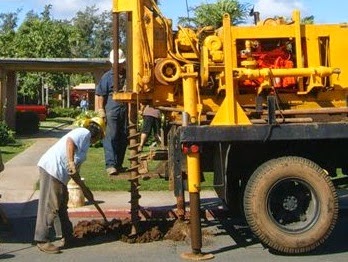
If you're doing mud-rotary or air-rotary drilling and there's potential to be standing in potentially contaminated gack, the number one way to limit exposure is to not be standing in it. The only person who should be in there is the helper(s) who are mucking out the mud tub. In those cases, the helper will often wear a pair of steel-toe rubber boots. Usually the driller stands on a little fold-out platform at the controls (see below, from here) and only rarely has to stand in the cuttings.
With that said, steel-toe rubber boots are a good back-up in certain situations: They can help in the winter if you're going to be standing in a snowbank or a puddle of slush all day. They're also useful if you find yourself in a truly hazardous or gross material and you need to decontaminate your boots. For example, when I was trying to add enough extra bentonite and wood shavings to stabilize a roll-off container of contaminated slop so that it could be picked up by the hauler without sloshing out the back. Standing in a roll-off box and smushing wood shavings into slop by standing on a pile and kicking it around is not my finest moment.
To sum up: lace-up, over the ankle steel toe boots! Unless sloppy mess, in which case rubber boots are ok. Maybe. It can be complicated out there.
The minimum standard is steel-toe boots. I worked for one organization that required steel shanks as well, which put all those Dr. Martens I like so much out of contention. I haven't run into metatarsal-protecting requirements for myself (particularly ugly example here) although I know some health and safety folks who have a pair tucked away. Often reimbursement requires proof that the boots meet ANSI standards.
I often see steel-toe other things in stores and on websites. Steel-toe sneakers. Steel-toe clogs (!?). Steel-toe dress shoes. In the environmental business, you need to have lace-up boots. Some organizations are more or less picky about ankle support, but generally low-cut boots are frowned on. A drilling location at an environmental site is generally comparable to an early-phase construction site, with lots of hoses lying around, vehicles coming in and out, uneven terrain, and mud or dust. The primary hazard is vehicular and slip-trip-fall. Worst-case scenario, you need the ability to skedaddle, and slip-on shoes don't help.
If you're doing mud-rotary or air-rotary drilling and there's potential to be standing in potentially contaminated gack, the number one way to limit exposure is to not be standing in it. The only person who should be in there is the helper(s) who are mucking out the mud tub. In those cases, the helper will often wear a pair of steel-toe rubber boots. Usually the driller stands on a little fold-out platform at the controls (see below, from here) and only rarely has to stand in the cuttings.
With that said, steel-toe rubber boots are a good back-up in certain situations: They can help in the winter if you're going to be standing in a snowbank or a puddle of slush all day. They're also useful if you find yourself in a truly hazardous or gross material and you need to decontaminate your boots. For example, when I was trying to add enough extra bentonite and wood shavings to stabilize a roll-off container of contaminated slop so that it could be picked up by the hauler without sloshing out the back. Standing in a roll-off box and smushing wood shavings into slop by standing on a pile and kicking it around is not my finest moment.
To sum up: lace-up, over the ankle steel toe boots! Unless sloppy mess, in which case rubber boots are ok. Maybe. It can be complicated out there.
Friday, April 25, 2014
to the internet!
I've become a lot more, um, substantial since I first started out in environmental consulting. I had an old pair of carhartts for ages, and at first they were way too big, and they hung off my hips and I had to roll them up. Now they sit at my natural waist (just barely) and they leave angry red lines across my stomach if I have to sit for any length of time. And they don't need to be rolled up anymore.
I ran into another short geologist the other day, and she greeted me with, "Your pants! They're short!"
There is a special kind of bond between ladies who can't find the right size. So I just laughed and said, "you gotta use the internet!". Because you just can't find field pants in short lengths in the store. Same thing with my epic adventures trying to find small enough steel-toe boots. And specialty boots, like steel-toe rubber boots for the really messy jobs? Forget it!
And about those pants... besides the carhartts, there's also red ant and duluth trading co for the more heavy duty stuff and then REI/EMS/other outdoors places for lighter-duty (and warmer weather) stuff. Now, if I can only remember to order something ahead of time, and not right after I've destroyed my last good pair by kneeling in a puddle of corrosives or getting stuck on a barbed-wire fence...
I ran into another short geologist the other day, and she greeted me with, "Your pants! They're short!"
There is a special kind of bond between ladies who can't find the right size. So I just laughed and said, "you gotta use the internet!". Because you just can't find field pants in short lengths in the store. Same thing with my epic adventures trying to find small enough steel-toe boots. And specialty boots, like steel-toe rubber boots for the really messy jobs? Forget it!
And about those pants... besides the carhartts, there's also red ant and duluth trading co for the more heavy duty stuff and then REI/EMS/other outdoors places for lighter-duty (and warmer weather) stuff. Now, if I can only remember to order something ahead of time, and not right after I've destroyed my last good pair by kneeling in a puddle of corrosives or getting stuck on a barbed-wire fence...
Thursday, April 17, 2014
promotional items
I've collected a vast array of promotional items from conferences, subcontractors, and "technical lunches" where a vendor is trying to sell something and we're trying to score free food. So here's the Short Geologist's guide to common promotional gear, from least to most useful.
1. baseball cap: If I'm outside, I'm wearing either a hard hat or a wide-brimmed sunhat. A baseball cap is useless to me. And even if I were a baseball cap-wearer, how many caps could I possibly need? Or if a baseball cap is an intrinsic part of my personal style, would I really wear a cheap one with "bob's tanks" or whatever printed on it?
2. CD of promotional material: Not reusable and if I really needed that info, I could look it up on your website in 12 seconds, rather than rummaging around for a CD on my desk. If you hand me a sheaf of papers, I can at least use the back to scribble notes on.
3. Cheap windbreaker: I need raingear that actually works because there's a good chance I'll be out for hours and hours in inclement weather. If it doesn't keep me dry after 3 uses, it's just going to take up closet space.
3. Polo t-shirt: This is a sensitive topic because when you receive a polo shirt from your employer it's supposed to be a Nice Thing. I have a couple problems with company polo shirts: they're impossible to layer under anything; they're never quite the right size; and at least where I've worked, they were really only appropriate for casual Fridays at the office. In the summer. When you were sure that the air conditioning wouldn't kick on. They were nice for my instructing gig if the room was super hot, but that was about it.
4. Miscellaneous tchochkes: I don't need more magnets, CD openers, luggage tags, or corkscrews, but they're small and inoffensive.
Ok, on to the stuff I actually appreciate:
5. good ballpoint pen: not fancy pens, but working pens. Pens that have retractable points (clicky pens) are best, but I'm just looking for something that won't ooze globs of ink when writing or disintegrate at the bottom of a backpack. For some reason, every place I've worked has cheaped out on pens and it drives me bonkers.
6. Food: I'll eat anything, really. For my personal use, reasonably healthy snacks (granola bars, nuts) are best because they work with both travel and fieldwork. But field crews love when vendors send a big box of chocolates to the trailer.
7. Bag: I've gotten reusable grocery bags, canvas tote bags, insulated bags for picnics/bringing over stuff for potlucks, and duffel bags. All are appreciated, and they pack away to essentially nothing when not in use.
8. regular t-shirt: the stuff I get from vendors is usually sized mens' large or bigger, but I can always use t-shirts to sleep in. Bonus if it's actually sized for me (for an undershirt, if nothing else).
9. Thumb drive: you can never have too many of these. Especially if you're working with contractors who are producing draft data in the field, so you can send out the early results and get buy-in for field adjustments. Or you need a copy of an entire sub-directory so you can work remotely. Or your field printer breaks and you need to make a run to kinkos to print forms.
10. business card: I am a big believer in business cards and go through my own (I always have at least 10 with me) at an astounding rate. They're small, handy to write notes on, and they have the person's name on them so I can actually contact the right person later/spell their name correctly in the logbook. If I am trying to get information/access from someone, pre-emptively handing over a card prompts them to respond more readily than just firing questions.
Any major category I forgot?
1. baseball cap: If I'm outside, I'm wearing either a hard hat or a wide-brimmed sunhat. A baseball cap is useless to me. And even if I were a baseball cap-wearer, how many caps could I possibly need? Or if a baseball cap is an intrinsic part of my personal style, would I really wear a cheap one with "bob's tanks" or whatever printed on it?
2. CD of promotional material: Not reusable and if I really needed that info, I could look it up on your website in 12 seconds, rather than rummaging around for a CD on my desk. If you hand me a sheaf of papers, I can at least use the back to scribble notes on.
3. Cheap windbreaker: I need raingear that actually works because there's a good chance I'll be out for hours and hours in inclement weather. If it doesn't keep me dry after 3 uses, it's just going to take up closet space.
3. Polo t-shirt: This is a sensitive topic because when you receive a polo shirt from your employer it's supposed to be a Nice Thing. I have a couple problems with company polo shirts: they're impossible to layer under anything; they're never quite the right size; and at least where I've worked, they were really only appropriate for casual Fridays at the office. In the summer. When you were sure that the air conditioning wouldn't kick on. They were nice for my instructing gig if the room was super hot, but that was about it.
4. Miscellaneous tchochkes: I don't need more magnets, CD openers, luggage tags, or corkscrews, but they're small and inoffensive.
Ok, on to the stuff I actually appreciate:
5. good ballpoint pen: not fancy pens, but working pens. Pens that have retractable points (clicky pens) are best, but I'm just looking for something that won't ooze globs of ink when writing or disintegrate at the bottom of a backpack. For some reason, every place I've worked has cheaped out on pens and it drives me bonkers.
6. Food: I'll eat anything, really. For my personal use, reasonably healthy snacks (granola bars, nuts) are best because they work with both travel and fieldwork. But field crews love when vendors send a big box of chocolates to the trailer.
7. Bag: I've gotten reusable grocery bags, canvas tote bags, insulated bags for picnics/bringing over stuff for potlucks, and duffel bags. All are appreciated, and they pack away to essentially nothing when not in use.
8. regular t-shirt: the stuff I get from vendors is usually sized mens' large or bigger, but I can always use t-shirts to sleep in. Bonus if it's actually sized for me (for an undershirt, if nothing else).
9. Thumb drive: you can never have too many of these. Especially if you're working with contractors who are producing draft data in the field, so you can send out the early results and get buy-in for field adjustments. Or you need a copy of an entire sub-directory so you can work remotely. Or your field printer breaks and you need to make a run to kinkos to print forms.
10. business card: I am a big believer in business cards and go through my own (I always have at least 10 with me) at an astounding rate. They're small, handy to write notes on, and they have the person's name on them so I can actually contact the right person later/spell their name correctly in the logbook. If I am trying to get information/access from someone, pre-emptively handing over a card prompts them to respond more readily than just firing questions.
Any major category I forgot?
Subscribe to:
Posts (Atom)


