I got totally distracted by the Olympics recently because I finally got to watch some sports on TV that I used to participate in myself and that I only get to see every four years. And then I got out of the habit of writing posts. I got as far as copying down a link about explosive coworkers a couple of weeks ago from Ask a Manager.
But now I'm back! So. Explosive coworkers, a theme I have extensive experience with, especially if you extend "coworkers" to include drillers and other contractors.
AAM suggests that when dealing with someone explosive, you tell the person (calmly) that the exploder is being unreasonable and then come back later when they've calmed down.
I have never found that telling someone in a full-on rage that they're being unreasonable to be helpful. In fact, it's pretty obnoxious. Most explodey people know they're being unprofessional. But their professionalism isn't exactly high on the list they're focusing on at the moment.
If someone is clearly getting steamed up, I suggest a break/taking some time to vent. If possible, I'll busy myself with paperwork so that they can mutter about how everything sucks and storm around for a bit. But once someone is at the screaming/throwing things stage, there's nothing to do but to wait it out and then address the lack of professionalism afterward.
I have always been the person who smooths down ruffled feathers and soothes people who are freaking out. I do get pissed off by people who get all worked up and essentially force me to be the peacemaker, to the point of raging (internally) myself. On a very rare occasion, my "pollyanna" disposition has irritated someone even more, finally causing an epic blowout. This has actually worked out the problem (sometimes screaming back causes the aggressor to back off) but it's not exactly productive or a permanent solution.
Of course, if someone is actually threatening/directing animus directly at me, and not having a general freakout, I'm not quite as dispassionate. If someone screams at me, I'll tear up and we can throw professionalism out the window. Sigh.
Monday, August 20, 2012


Thursday, July 19, 2012
science and technology
I am a luddite. I do all my cross-sections and plane-view maps by hand (someone else digitizes my curves), I have a dumbphone, and I use boring old MS office (word, excel, and powerpoint) for everything. I even did a mini-series of posts about old-school tech (like light tables and semi-log paper) that isn't obsolete yet, dammit! So this month's accretionary wedge on geoscience and technology, hosted at Earth-Like Planet, had me stumped.
But you know what technology has revolutionized my work, both science and management? The advent of super cheap, super fast copier/printers with a scanner. Sure, cell phones and GPS devices and laptops with wireless thumb drives are handy for fieldwork. But they really just made life more convenient.
The ability to spend 50 bucks on a printer/scanner/copier and send stuff instantly has been a game-changer. Need the lab to handle your super-fast turnaround samples in a specific way? Scan and e-mail the chain of custody before the lab manager leaves for the night. Trying to figure out where to install a new monitoring well because now it's spring and your site is under 7 inches of water? Draw a quick field sketch and get the new location approved by a regulator while the drill crew is idling. Working remotely with another geologist and having a big argument over whether the bedrock is forming a ridge or a hill underground? Draw a cross-section and fire it over to bolster your theory. You borrowed fragile construction drawings from the 1950s? Scan the whole pile in 10 minutes and you have a permanent electronic repository. You've just convinced a neighbor to sign an access agreement, but now you need to prove to the lawyers that you're ok to be there? Scan and send.
I can go on forever. But the point is that geology is an extremely visual science. We need to draw maps and cross sections to figure out relationships that we can't see directly, or to synthesize information from a multitude of sources. And in environmental consulting, you have clients, regulators, subcontractors, and coworkers who you need to share that information with in order to make decisions.
Once I got access to a big, fast in-office scanner and an el cheapo field scanner/printer to go with my laptop, my life got so much easier and my actual technical output improved. And isn't that the goal of new technology?
But you know what technology has revolutionized my work, both science and management? The advent of super cheap, super fast copier/printers with a scanner. Sure, cell phones and GPS devices and laptops with wireless thumb drives are handy for fieldwork. But they really just made life more convenient.
The ability to spend 50 bucks on a printer/scanner/copier and send stuff instantly has been a game-changer. Need the lab to handle your super-fast turnaround samples in a specific way? Scan and e-mail the chain of custody before the lab manager leaves for the night. Trying to figure out where to install a new monitoring well because now it's spring and your site is under 7 inches of water? Draw a quick field sketch and get the new location approved by a regulator while the drill crew is idling. Working remotely with another geologist and having a big argument over whether the bedrock is forming a ridge or a hill underground? Draw a cross-section and fire it over to bolster your theory. You borrowed fragile construction drawings from the 1950s? Scan the whole pile in 10 minutes and you have a permanent electronic repository. You've just convinced a neighbor to sign an access agreement, but now you need to prove to the lawyers that you're ok to be there? Scan and send.
I can go on forever. But the point is that geology is an extremely visual science. We need to draw maps and cross sections to figure out relationships that we can't see directly, or to synthesize information from a multitude of sources. And in environmental consulting, you have clients, regulators, subcontractors, and coworkers who you need to share that information with in order to make decisions.
Once I got access to a big, fast in-office scanner and an el cheapo field scanner/printer to go with my laptop, my life got so much easier and my actual technical output improved. And isn't that the goal of new technology?
Tuesday, July 17, 2012
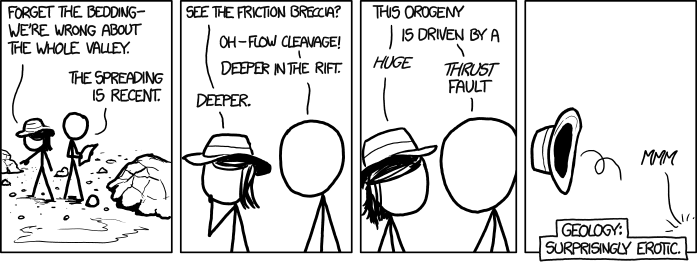
xkcd - geology
Another geologist sent me this, and I figured I'd share it with the wider geoblogosphere:
 Incidentally, XKCD is a terrific way to lose a couple of hours...
Monday, July 16, 2012
happy hour
I am not much of a drinker. I think my average alcohol consumption is about a drink per month.
However, there is nothing better than sitting down with a glass of (mediocre, in this case) red wine and lazily web browsing after a long day in the field. I've gotten all of my post-fieldwork e-mails taken care of, there are no obvious issues to stress out about on the horizon, I've showered, and for the first time since the weekend, I'm starting to feel human.
It's not on my list of necessary hotel amenities, but hotel happy hour is pretty sweet when I get it.
However, there is nothing better than sitting down with a glass of (mediocre, in this case) red wine and lazily web browsing after a long day in the field. I've gotten all of my post-fieldwork e-mails taken care of, there are no obvious issues to stress out about on the horizon, I've showered, and for the first time since the weekend, I'm starting to feel human.
It's not on my list of necessary hotel amenities, but hotel happy hour is pretty sweet when I get it.
Friday, July 13, 2012
trunk inventory
I'm between field jobs right now, and what that means is that everything that didn't make it back to the office is still in the car. So what useful items do I have right now?
1. A pair of quilted coveralls from the winter.
2. 2 bag filters for removing solids from water before sending through granular activated carbon.
4. Several bottles of sunscreen of varying ages and sun-blocking levels.
5. 3 bottles of drinking water.
6. Two knives.
7. One smushed roll of towels.
8. A half box of nitrile gloves, size medium.
9. A bright red sunhat.
10. Enough different tubing connectors to appear to be useful, but not enough to connect to any of the tubing that I may actually need.
11. Approximately 15 feet of bubble wrapping.
12. One roll of strapping tape.
13. One very large flashlight.
14. One pair of steel-toe boots, size 7.
15. A severely dented aluminum clipboard.
Having all thisjunk essential equipment readily at hand works well when you're called into the field at the last minute. It's not so great if you're going to meet a client and she chirps, "perfect! Let's take your car!"
1. A pair of quilted coveralls from the winter.
2. 2 bag filters for removing solids from water before sending through granular activated carbon.
4. Several bottles of sunscreen of varying ages and sun-blocking levels.
5. 3 bottles of drinking water.
6. Two knives.
7. One smushed roll of towels.
8. A half box of nitrile gloves, size medium.
9. A bright red sunhat.
10. Enough different tubing connectors to appear to be useful, but not enough to connect to any of the tubing that I may actually need.
11. Approximately 15 feet of bubble wrapping.
12. One roll of strapping tape.
13. One very large flashlight.
14. One pair of steel-toe boots, size 7.
15. A severely dented aluminum clipboard.
Having all this
Thursday, July 12, 2012
not just a notebook
I know I wrote about logbooks recently and a while back, but I'm going to that well again because the heat cooks off all my creativity.
I'm a big fan of adding stuff to logbooks, and not just local flowers. I'm fairly scatterbrained, and one of the best ways to keep organized is to keep everything in the logbook, and that way, I can just grab a single book (and a book that is bright yellow or orange for easy finding) when I get a phone call or need to run and take care of something.
I always spend a half hour or so before going into the field to get my logbook set up:
1. Write project, start date, logbook number, project number, and task on the front cover - and something identifiable on the spine.
2. Tape a business card to the inside front cover. Cover business card entirely with tape so that it's more or less waterproof.
3. Write all of the potential contact information I could ever need on the first page: contractors, project management, field personnel, porta-potty maintenance number...
4. Tape in a map that's been shrunk to fit so that I have some chance of finding the sample/drilling locations
and finally
5. Stuff a couple of critical pieces of paper, like copies of property access agreements, somewhere in the back third. They'll get dirty, wet, and will fly away when the pages of the logbook flap open in a moderate breeze. But I know they'll always be within a couple feet of me whenever I'm accosted by someone in authority.
This is how I pass as a reliable, competent field manager rather than the frazzled mess I actually am.
I'm a big fan of adding stuff to logbooks, and not just local flowers. I'm fairly scatterbrained, and one of the best ways to keep organized is to keep everything in the logbook, and that way, I can just grab a single book (and a book that is bright yellow or orange for easy finding) when I get a phone call or need to run and take care of something.
I always spend a half hour or so before going into the field to get my logbook set up:
1. Write project, start date, logbook number, project number, and task on the front cover - and something identifiable on the spine.
2. Tape a business card to the inside front cover. Cover business card entirely with tape so that it's more or less waterproof.
3. Write all of the potential contact information I could ever need on the first page: contractors, project management, field personnel, porta-potty maintenance number...
4. Tape in a map that's been shrunk to fit so that I have some chance of finding the sample/drilling locations
and finally
5. Stuff a couple of critical pieces of paper, like copies of property access agreements, somewhere in the back third. They'll get dirty, wet, and will fly away when the pages of the logbook flap open in a moderate breeze. But I know they'll always be within a couple feet of me whenever I'm accosted by someone in authority.
This is how I pass as a reliable, competent field manager rather than the frazzled mess I actually am.
Monday, July 2, 2012
mentoring, moving up
FSP broke her blog hiatus today to discuss mentoring by blogging. I would like to think that I am a mentor to young/inexperienced geologists through my blog, although I have neither the audience nor the blogging stamina of FSP (how on earth did she find time to think up and then write so many posts for so long?).
One of the milestones of being a professional, for me, is that I have started to become a mentor to other geologists. And one of the most concrete ways I can do that is by being a reference.
Whenever I applied to jobs or to school, I always felt like it was a big imposition to ask someone to be a reference for me. But I've been around long enough that younger geologists are asking me to be a reference. And it's not an imposition. At all. I am happy for my mentees that they are moving up in their career. Even the most convoluted reference questionnaire reminds me of the hoops I jumped through to get where I am today (I'm looking at you, grad school applications!) and brings back memories of starting out my career.
Of course, I may be overly cheerful about giving references because when I've had to fill out the written ones, I've been thoughtfully provided with a pre-addressed and stamped envelope and more than a week to fill them out. I've also genuinely respected the folks who have asked me for references. So maybe the moral of the story is to pick your references wisely and make their lives a little easier by doing as much of the work for them as you can.
One of the milestones of being a professional, for me, is that I have started to become a mentor to other geologists. And one of the most concrete ways I can do that is by being a reference.
Whenever I applied to jobs or to school, I always felt like it was a big imposition to ask someone to be a reference for me. But I've been around long enough that younger geologists are asking me to be a reference. And it's not an imposition. At all. I am happy for my mentees that they are moving up in their career. Even the most convoluted reference questionnaire reminds me of the hoops I jumped through to get where I am today (I'm looking at you, grad school applications!) and brings back memories of starting out my career.
Of course, I may be overly cheerful about giving references because when I've had to fill out the written ones, I've been thoughtfully provided with a pre-addressed and stamped envelope and more than a week to fill them out. I've also genuinely respected the folks who have asked me for references. So maybe the moral of the story is to pick your references wisely and make their lives a little easier by doing as much of the work for them as you can.
Subscribe to:
Posts (Atom)


